
EU on track to meet 2030 emissions target

According to a recent analysis by the European Commission (EC), the EU is on track to meet its 2030 net emissions reduction target of 55%. Based on member states' planned efforts, the EC expects net greenhouse gas emissions to fall by 54% by 2030 compared to 1990 levels. As such, the projected decrease is only 1 percentage point away from the emission reduction target. The EU is also roughly on track for the renewable energy target as the EC estimates that 41% of the EU's energy will come from renewable sources by 2030, just short of the targeted 42.5%.
So on the face of it, the EC report looks very rosy. Yet there are reasons to take the EC's expectations with a grain of salt. For example, many national plans remain vague about how the planned efforts will be financed and implemented. Moreover, 2030 is only an interim benchmark. The EU's most important goal is to achieve climate neutrality by 2050. This goal will require increasing efforts and this at a time when (political) support for the fight against climate change has declined.
2030 net emissions target within reach
A few months ago, the European Commission published its analysis of the EU member states' National Energy and Climate Plans (NECPs). In these NECPs, EU countries must outline what actions and policies they will take to meet their climate and energy targets over a given period of time. The NECPs recently reviewed by the EC are the final updated versions for the period from 2021 to 2030, submitted in 2024.
Based on the submitted NECPs, the EC calculated the total net emission reductions that will be achieved by 2030 (compared to 1990 levels). According to this calculation, the net emission reduction would reach 54%, thus very close to the legally set target of 55%. The target for the share of renewable energy (42.5%) would also be missed by only a hair (41%).
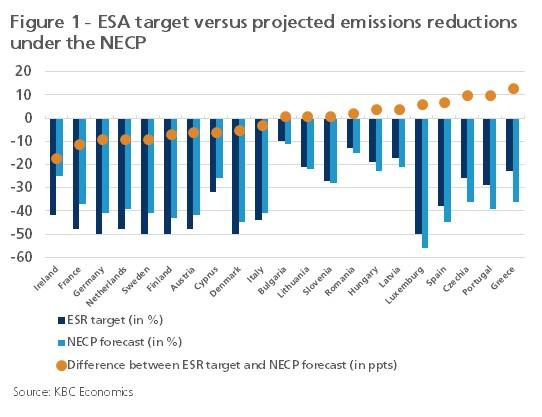
For greenhouse gas emissions covered by the Effort Sharing Regulation (ESA) system (emissions from transport, households, trade & services, agriculture and waste), the EC estimates that all countries combined will achieve a 38% reduction in emissions from 2005 levels by 2030. This lands the projected reduction 2 percentage points below the 40% target. Figure 1 shows the ESA targets and expected emissions reductions for the countries that submitted their NECP before the deadline. Those figures show that about half of the EU countries are not meeting their ESA target, with Ireland, France, Germany and the Netherlands as the biggest deficit countries. On the other hand, with the exception of Spain, we see that mostly small countries are forecasting more emission reductions than necessary to meet their national ESA target.
Upward potential?
Belgium was late in submitting its final updated NECP, partly due to the difficult government formation process. Slovakia, Poland and Estonia also missed the deadline, so their projected contribution to total EU emission reductions has yet to be factored in by the EC. When this will happen is unclear because the NECPs of Belgium and Poland have still not been submitted. The inclusion of the missing NECPs is likely to have a positive impact on the overall EU emission reduction, as the final NECPs were supposed to be more ambitious than the provisionally updated versions submitted in 2023 (and used by the EC in its calculations). It is therefore possible that the EC could still finally conclude that the 55% target is achievable.
Important disclaimer
As cited, the EC's analysis is based on member states' NECPs. Meeting the 2030 target hinges on full implementation of existing and planned measures from the NECPs. And this raises serious doubts with climate organisations. Climate Action Network Europe argues that in many cases the NECP remain vague about the sources of funding for climate plans and that there is often too little coherence between the various initiatives. Moreover, many countries, including Bulgaria and Denmark, rely on technologies whose effectiveness has not yet been proven. There is also criticism that many NECPs do not include concrete timetables and phase-out measures for fossil fuel subsidies. A criticism that the EC itself also expresses in its report. Finally, the EC also indicates that most plans do not include sufficient adaptation measures to cope with the consequences of climate change.
An uphill battle
The ultimate EC goal is to become climate neutral by 2050. Even with an interim 2030 success, the road to 2050 remains long, especially as, in most cases, the low-hanging fruit has already been picked.
Moreover, political climate fatigue is growing, both globally and within the EU. The green parties lost seats in the 2024 European elections, which resulted in an adjustment of the EU strategy from a predominant focus on sustainability to a combination of sustainability and productivity, competitiveness and innovation. The difficult course of negotiations on setting the net emissions reduction target for 2040 is a sign of the more difficult waters in which the climate agenda will find itself in the coming years.