
Is a blue wave coming in the US?
Click here to open the PDF

On 3 November, US voters will again head to the polls. All US House members, a third of US Senators and 36 governors will be up for election. As affordability concerns are driving President Trump’s popularity down, Democrats have obtained a sizeable 8.9 percentage point generic ballot polling lead. This makes them the clear favourites to win the House and gives them a decent chance to take control of the Senate. The election will have important economic consequences as the Iran war, the rule of law, Fed independence, state regulation and congressional redistricting are all on the ballot.
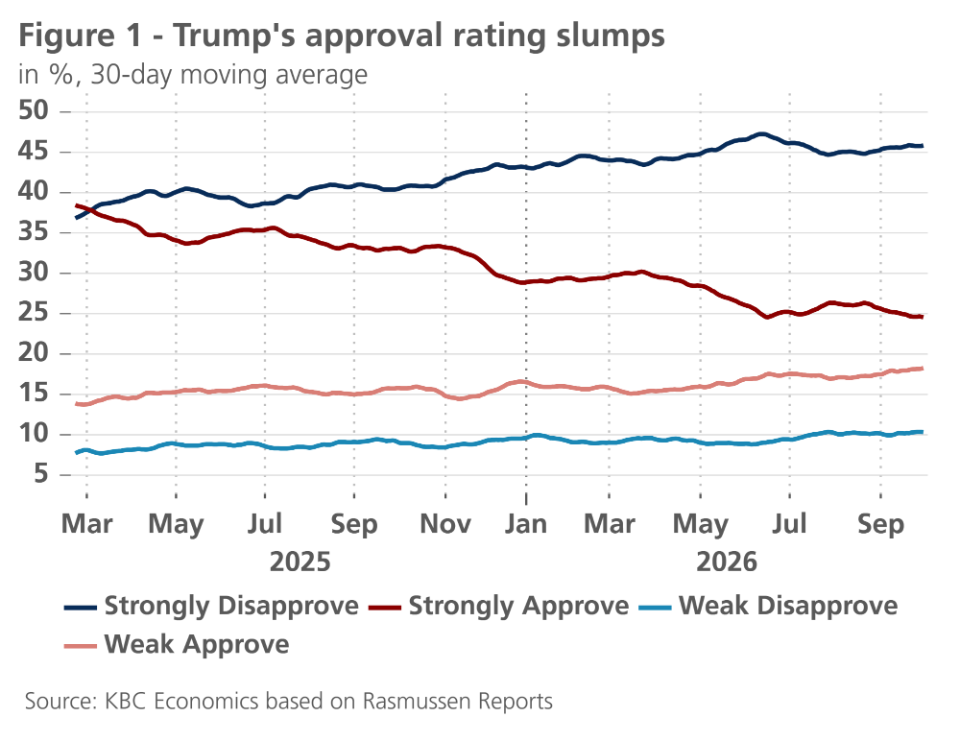
The US midterms, held on 3 November, are typically a referendum on the ruling president, often translating into a significant loss for the party in power. Another shift in the balance of power is likely this November. As Donald Trump’s approval rating is deeply under water (see figure 1), Democrats obtained a sizeable lead of +8.9 percentage points on the generic ballot in polling averages.
The economy again features prominently in this midterm campaign. Inflation, in particular, is top of mind for many voters. 33% of voters cite inflation and prices as the most important issue facing the US (according to YouGov polling). This is unsurprising. Since January 2021, the overall CPI price index has increased by 27%. Still today, CPI inflation runs at 3.4% year-on-year.
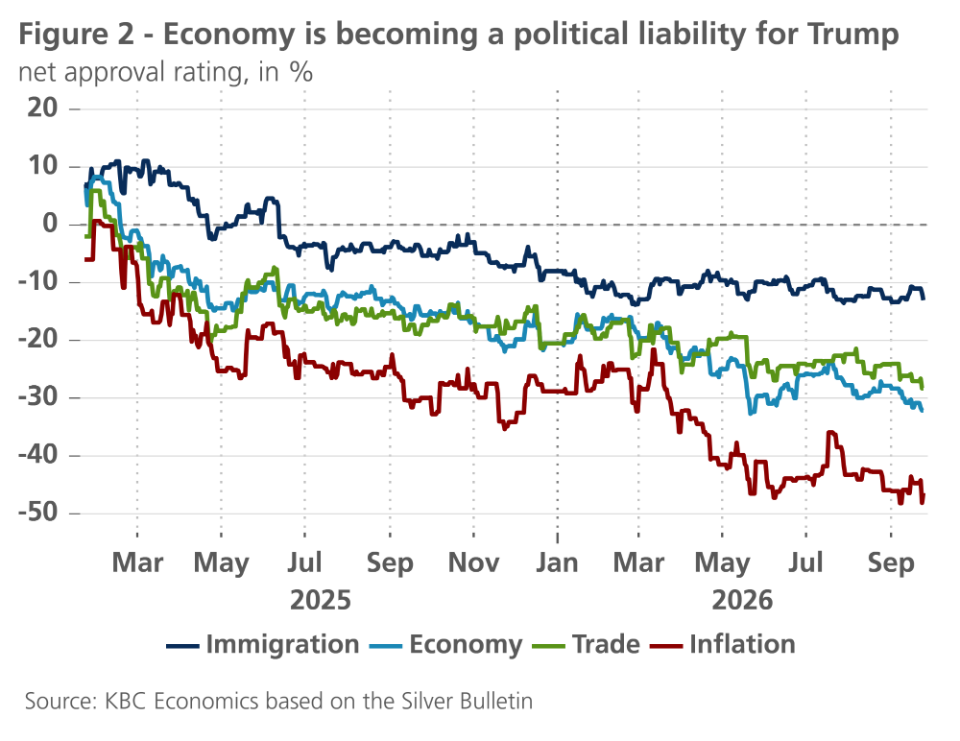
Cost-of-living issues likely helped Trump to return to power. Back in 2024, voters trusted Donald Trump more than Kamala Harris on this issue. Nowadays, Trump is deeply under water on this topic, as his trade policies and the Iran war drove up goods and energy prices. His approval rating on other major issues has also dropped into deeply negative territory (see figure 2).
Democrats favoured to control the House
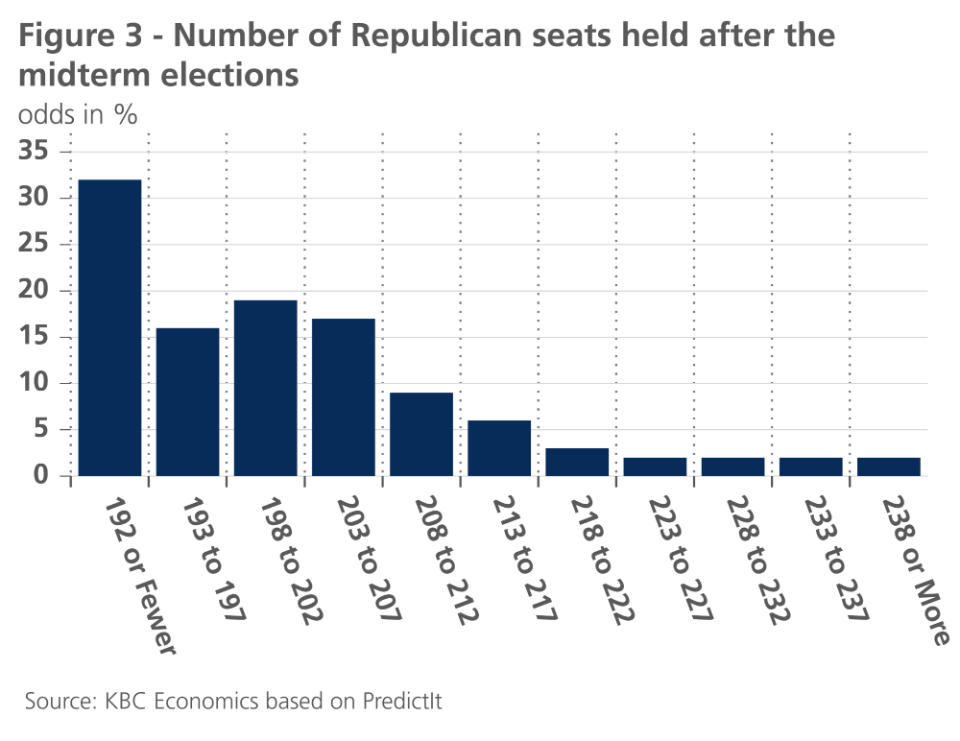
As House members are elected for a period of only two years, all members of the House are up for reelection in November. Republicans only narrowly kept control of the House in 2024 with a 220 to 215 majority. It will be challenging for Republicans to maintain this majority. Since the Second World War, the president's party has lost an average of 26 seats in the House during the midterm elections. History is set to repeat itself in 2026. Prediction markets give Republicans only a 8.5% chance of maintaining control of the House. They even suggest there’s a 32% chance Republicans will hold less than 193 seats after the midterms (see figure 3). The prediction model of The Economist only gives Republicans a 5% chance to win the House.
If Democrats capture the House, this could have important economic implications. Democrats would gain control over economic committees such as the House Financial Services Committee, the House Ways and Means Committee, the House Oversight and Government Reform Committee and the House Budget Committee. This will allow them to conduct investigations related to a.o. trade policy, financial regulation, antitrust cases, government contracts and so on.
Control of the House would also allow Democrats to block Trump’s legislative agenda. That said, most of Trump’s legislative agenda was incorporated in Trump’s One Big Beautiful Bill Act (OBBBA) passed last year (see also our research report of 16 September 2025). The bill included a.o. major tax cuts, cuts to social security spending and increased funding for immigration control. The OBBBA also raised the debt ceiling from 36.1 trillion to $41.1 trillion USD. According to the Bipartisan Policy Center, this limit will be reached in the middle of next year, possibly setting the stage for a new debt ceiling fight. Democrats could also still threaten to shut down the government to extract political concessions, however.
Democrats could also try to constrain Trump’s war efforts in Iran, though the legal avenues are limited. The most effective way to end the war would be to pass a joint resolution. Yet President Trump could veto it. Congress could overturn the President’s veto with a two-thirds majority in both chambers, which is unlikely to happen. A more effective way would thus be to constrain funding for the war. A Democratic House would not have the power to cut off already appropriated funding, but it could block supplemental funding requests for the Iran war.
Tight battle for the Senate
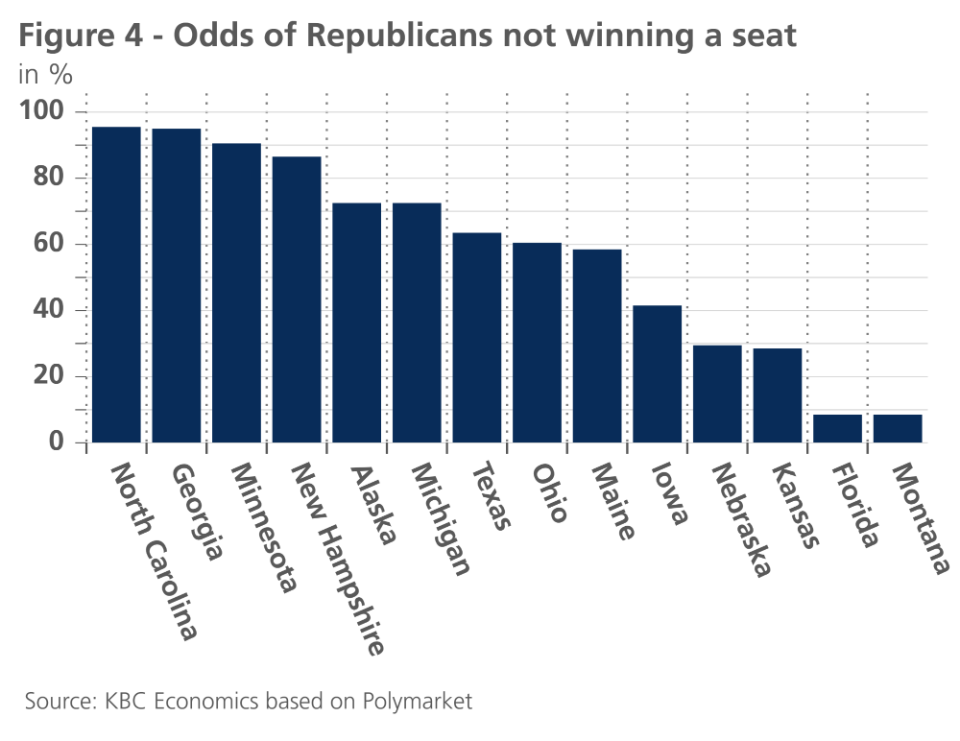
Retaking control of the Senate will be more challenging for Democrats. Republicans currently have a 53-47 majority, so Democrats would have to net four seats to retake control of the Senate. As US Senators are elected for a 6-year term, only 35 seats are up for reelection. Though 22 of those are currently held by Republicans, only one of those seats is from a state that Kamala Harris won (i.e. Maine). Only one other seat is from a state that Donald Trump narrowly won (i.e. North Carolina). Democrats thus have to gain at least two seats in states that Donald Trump won with a margin of more than 10 percentage points. Nonetheless, given the favourable political environment for Democrats, they have a fighting chance in some of those states (see figure 4). Democrats are seen as favourites to win the Alaska, Ohio and Texas Senate races and are the slight underdog in the Iowa Senate race. Because of that, prediction markets give Democrats a 63% chance of retaking the Senate (same odds as The Economist prediction model).
The outcome of the Senate elections is arguably more important than the outcome of the House elections. The US Senate not only has legislative authority but also has the power to confirm or reject several presidential nominations. The appointments of cabinet secretaries, along with many deputies and under-secretaries, require Senate approval. The appointment of most federal judges (including Supreme Court Justices) and many US attorneys require presidential nomination and Senate confirmation. A Democratic Senate take-over of the US Senate would thus hinder Trump’s current assault on the rule of law. Several heads of commissions and regulatory agencies (such as the Securities and Exchange Commission, the Commodity Futures Trading Commission and the Consumer Financial Protection Bureau) also require Senate approval.
Most importantly, from an economic perspective, is the requirement of Senate confirmation of all seven members of the Federal Reserve Board of Governors. Former Fed-Chair Jerome Powell’s term as governor expires in January 2028. A Democratic Senate takeover would thus blunt Trump’s current assaults on the Fed’s independence, as Trump wouldn’t be able to replace him by a more pliant governor.
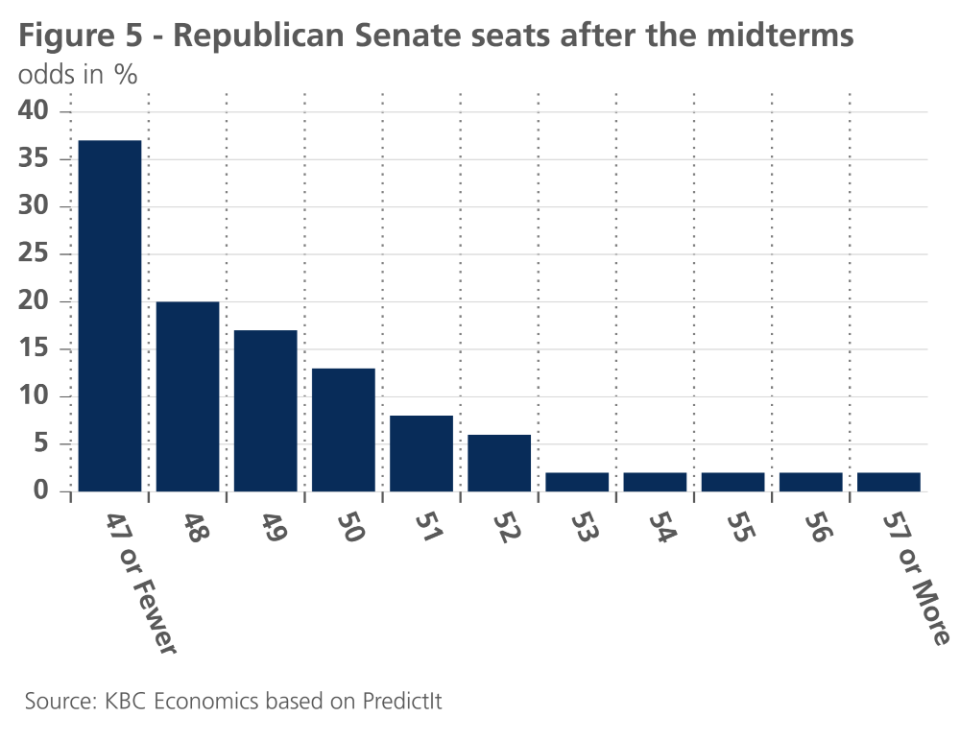
The current Senate elections also have implications for 2028 and beyond, as Senators are elected for 6-year terms. A strong Democratic outcome would increase their chances of obtaining a government trifecta in the next presidential elections, while a Republican overperformance would blunt their chances. Democrats currently have 39% chance of have 53 or more senators after the midterms, while Republicans only have 10% chance of having 53 or more senators after the midterms (see figure 5).
State elections also matter
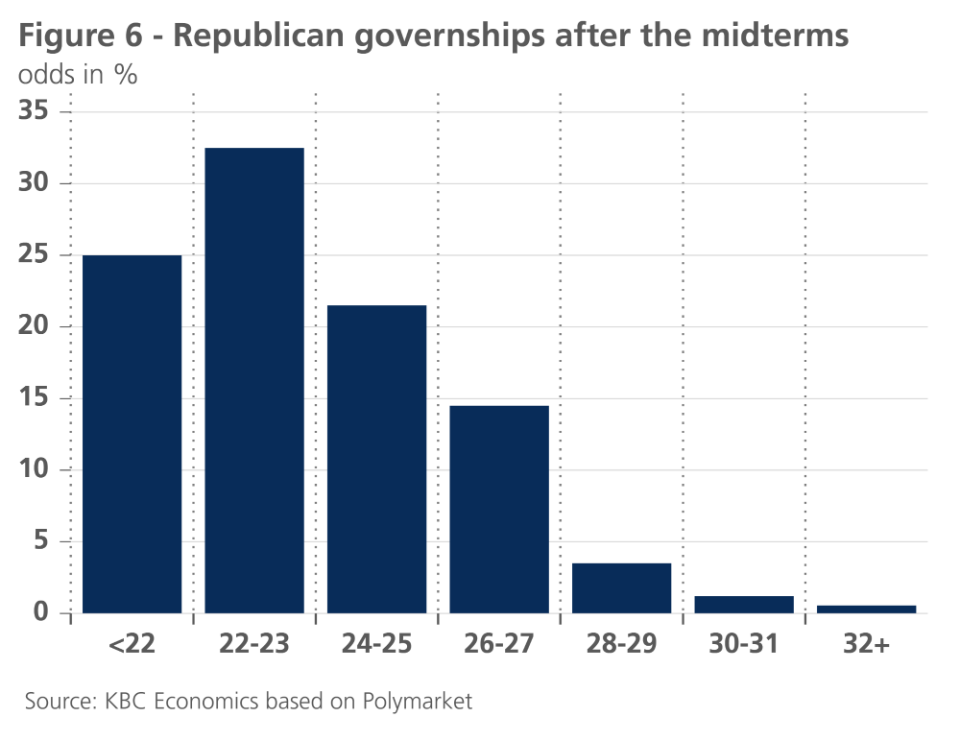
Aside from federal elections, important elections will also be fought at the state level. Most state legislative chambers will hold elections, and 36 governors are up for election. Republicans currently hold 26 out of 50 governorships, but that is likely to change after the election (see figure 6). These local elections matter as many policies such as tax policies and important regulations (on the environment, zoning, artificial intelligence and so on) are set at the state level.
Furthermore, these local elections could have important implications for control of the US House from 2028 onwards. State governments are responsible for drawing the boundaries of federal House districts in their state. Some state officials draw these electoral boundaries in a way that gives their party an unfair advantage in House elections (so-called gerrymandering). Though both Democrats and Republicans practice gerrymandering, Republicans have gerrymandered more aggressively. They recently redrew maps in several states. As a result, according to Precision Analytica, Democrats now need to win the popular vote by 3.5 percentage points to gain control of the House. If Democrats were to gain more control of State governorships and legislative chambers, they could rebalance things.
Conclusion
The stage is set for another important US election in November. If Democrats gain control of the House, they could block Trump’s legislative agenda and launch a torrent of investigations. Yet Senate control would be the bigger prize for Democrats, as that would allow them to block controversial nominations. The elections will also affect control of state governments with important regulatory implications. Finally, these elections set the stage for the crucial 2028 presidential elections. If Democrats perform strongly in the Senate and at the local level this year, that will increase their odds of gaining a trifecta in 2028.