
The consequences of the blue tsunami in the US

The Democrats made major gains in last week’s midterms. They gained solid majorities in both the US House of Representatives and US Senate. They also scored important victories in state elections. The midterm outcome will have important economic consequences, as they could alter Trump’s immigration and trade policies and could slow down AI investments. They could also change the course of the Iran war. They also set the stage for the 2028 election, where Democrats are now seen as clear frontrunners.
Introduction
The latest midterms caused a political earthquake in Washington. Two years after Trump was voted back into office, voters delivered a vote of no-confidence on his economic policies. Republicans lost the popular vote by around 13 percentage points, the largest midterm loss since 1974 and thus lost control of both chambers of Congress. In the House of Representatives, 256 races have been called for Democrats versus 166 races for Republicans. 13 seats have yet to be called, with Democrats in the lead in three of them.
Democratic gains in the Senate are even more impressive. Democrats flipped seven Republican seats, most of them in historically deep-red states. Two races (Alaska and Mississippi) have yet to be called. However, prediction markets now give the Democratic candidate a higher than 90% chance to win in both races. If those two races are called in favour of Democrats, they would end with a solid 56-44 majority.
Democrats also made major gains in state elections. Democrats flipped five governor races. Two races (Alaska and Kansas) have yet to be called, yet prediction markets also see Democrats as heavy favourites in those races. Democrats also gained government trifectas (i.e. control of the governorship and state house and senate) in six additional states. 54% of the US population will now live in states with a Democratic trifecta (up from 40% prior to the election). In contrast, only 24% of Americans will now live in states with a Republican trifecta (down from 40% prior to the election). Three quarter of the population will live in a state run by a Democratic governor.
Short-term consequences at the state level
How Democrats will use their electoral gains is an open question. They have the most leeway to change things at the state level. There, in general, Democrat-controlled governments tend to favour higher and more progressive taxation in support of higher government spending in areas such as healthcare and education. They also tend to support stricter regulations (e.g. on labour laws or the environment). Democratic governors are also less likely to cooperate with federal immigration enforcement agencies.
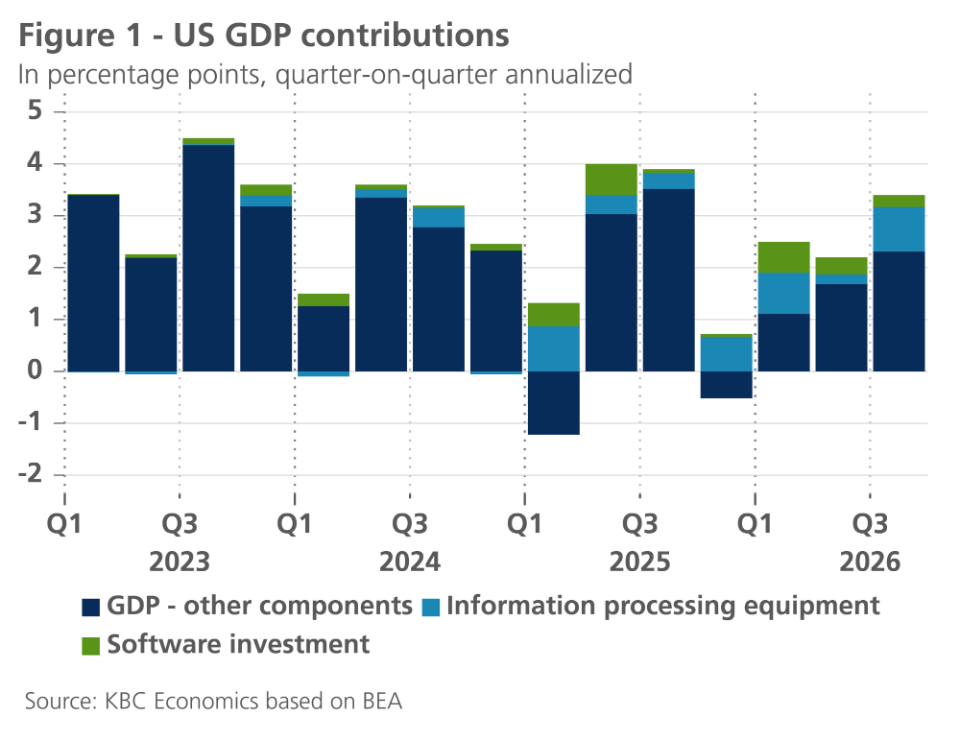
Democratic governors and lawmakers might also slow down the current data center build-out, which has been the major driver of recent US growth (see figure 1). Democrats flipped the governorship in three of the most important data center states (i.e. Texas, Ohio and Georgia). In Texas, the state with the most planned data center capacity, Texas governor-elect, Gina Hinojosa, promised an immediate moratorium on their construction. Furthermore, there were 41 data center-related ballot measures on the ballot across the US. In 40 of those, voters backed restrictions or rejected pro-development proposals.
Short-term consequences at the federal level
How the Democratic victory will shape policymaking at the federal level is more uncertain. Control of the House puts Democrats in the lead of major economic committees. This will allow them to conduct investigations related to a.o. trade policy, financial regulation, antitrust cases, government contracts and so on.
Control of the Senate allows Democrats to confirm or reject several president nominations, including cabinet secretaries, federal judges, US attorneys and heads of regulatory agencies. The US Senate also confirms presidential nominations to the Federal Reserve Board of Governors. Democratic Senate control will thus blunt Trump’s attacks on Federal Reserve independence.
Democratic take-over of both chambers will block the Republican legislative agenda. That said, Democrats will not be able to pass laws by themselves as they do not have a veto-proof majority. They will thus probably have to cooperate with President Trump to pass legislation. Encouragingly both sides have shown willingness to strike deals. In a recent interview, Trump expressed a willingness to work with Democrats on AI safety regulation. Trump also hinted that his deportation campaign was too harsh and that he was open to providing a pathway to citizenship for some undocumented immigrants. However, Trump’s promotion of immigration hardliner Stephen Miller as chief of staff is somewhat at odds with his statements on immigration. Other areas of collaboration could be on permitting reform and health care access. However, Democratic congressional investigations into the Trump administration and Department of Justice investigations of Democratic lawmakers might derail collaboration between the Trump administration and the Democratic Congress.
Democrats might also collaborate with other Republican lawmakers to pass laws with veto-proof majorities. Though Trump held a firm grip on the Republican party prior to the midterm election, several Republicans have criticized Trump and his economic policies since the severe midterm loss. As Trump’s grip on his party loosens, Republican lawmakers might go against his administration in certain areas. This might especially be the case for Trump’s trade policies, which are at odds with traditional Republican views. Republican and Democratic lawmakers might possibly collaborate to constrain presidential tariff-setting powers.
The midterm loss could also alter the course of the Iran war. Several Republicans, including Vice-President Vance and President Trump himself, admitted that the Iran war and the resulting rise in energy prices was a key driver of the electoral defeat. In anticipation of a possible deescalation in the war, Brent oil prices declined by 7% the day after the midterms.
Consequences for 2028
The midterms will also set the stage for the crucial 2028 presidential election. Given the size of the midterm victory, Democrats are seen as clear favourites to regain the presidency (with a 71% chance according to prediction markets). If they gain the presidency, they are likely to maintain full control of Congress. Odds of this so-called Democratic trifecta are now at 65%.
In contrast, even if Republicans manage to win the presidential election, they are unlikely to regain control of Congress. Odds of a Republican trifecta are only 13%. Especially regaining control of the Senate in 2028 will be challenging for Republicans (18% chance), as Republicans will normally need to net at least six seats to regain control of the Senate. Only five Democrats up for reelection in 2028 come from a state that Trump won, so Republicans will have to gain at least one Senate seat in a blue state to regain control.
Regaining control of the House will also be challenging for Republicans (21% chance). Not only is there now a big Democratic cushion (of at least 38 House seats), but Democrats could also use their gains at the state level to press the redistricting battle in their favour. State governments are responsible for drawing the boundaries of federal House districts in their state and they sometimes draw these electoral boundaries in a way that gives their party an unfair advantage in House elections (so-called gerrymandering). Republicans have recently redrawn maps in their favour in several states. However, thanks to their state-level victories, Democrats are likely to retaliate and gerrymander in states they now control. Notable in this respect is that Maryland passed a ballot measure to relax constraints on congressional redistricting.
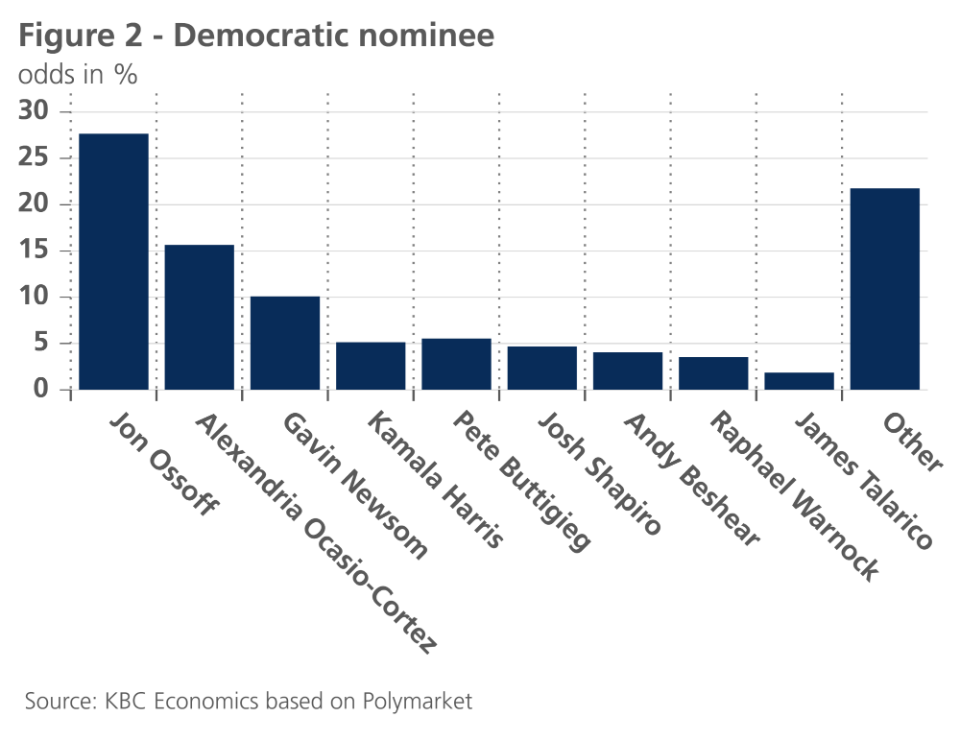
It’s unclear on what policy platform both parties will run on in 2028. For the Democratic party, the most likely contenders are mostly moderate Democrats (see figure 2). Only Alexandria Ocasio Cortez is from the left wing of the party.
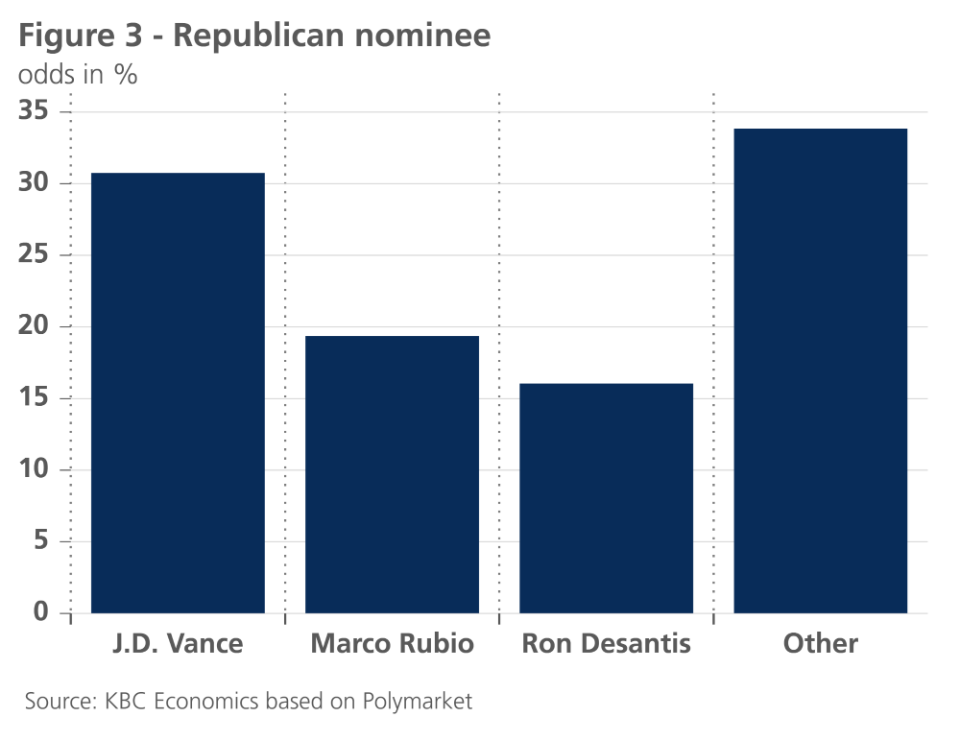
On the Republican side, prediction markets see current vice-president Vance and secretary of state Rubio as frontrunners (see figure 3). The former is seen as closer to Trump’s MAGA movement, while the latter is viewed as a more traditional Republican. Florida governor Ron De Santis is also seen as a possible strong contender.