

Belgium climbs to 12th place in the KBC Country Sustainability Barometer


Since 2002, KBC Economics has calculated the sustainability profile of countries on an annual basis. This calculation produces a country ranking, known as the KBC Sustainability Barometer, which serves as an input for the investment choices in government bonds for KBC’s Responsible Investing (RI) funds. In the latest update of the ranking, made end 2025, Belgium scores 12th in the group of 163 (both developed and emerging) countries considered, after ranking 17th in the screening made end 2024. That is quite an improvement and a trend reversal, as Belgium had lost several places in the ranking in previous years. Compared to neighbouring Germany, the Netherlands and Luxembourg, Belgium’s sustainability performance is still slightly worse, though. Belgium owes its recent improvement in the barometer to its better score on ‘Environmental performance and commitment’ (one of the five sustainability themes in the analysis). However, at 51st place, Belgium’s performance in this theme remains relatively poor, implying that there is still some way to go in that area.
Countries that invest in the sustainable promotion of the general well-being of their population thereby lay the foundations for favourable and stable political-economic developments in the future.1The sustainability performance of countries, in combination with the traditional ratings of credit rating agencies, is thus a powerful tool to assess the risk of government bonds and make better-informed investment decisions.
In our analysis, we define a country’s sustainability as ’the set of achievements, institutions and policy efforts that promote the well-being of the current and future population in a sustainable manner, without compromising the well-being of populations in other countries and the environment’. To measure it, we use a scoring model based on five themes: (1) General economic performance and stability, (2) Socio-economic development of the population, (3) Equality, freedom and rights of the population, (4) Environmental performance and commitment, and (5) Peace, security and international relations. Each theme is in turn subdivided into three sub-indicators. A more detailed description of the screening approach, as well as the most recent country ranking (the so-called KBC Country Sustainability Barometer) can be found in a KBC Research Report published together with this opinion.
12th place out of 163 countries
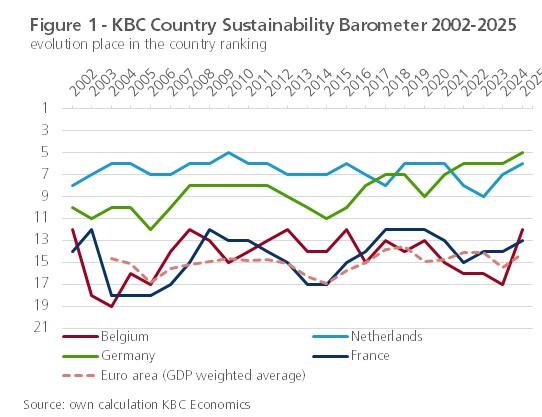
In the latest update of the country screening, recently finalised, Belgium obtains 12th place out of a total of 163 (developed and emerging) countries considered. This is quite an improvement compared to the previous screening (Belgium ranked 17th in the 2024 update) and reverses the worsening trend seen in previous years. When we compare Belgium with neighbouring Germany, the Netherlands and Luxembourg, its sustainability performance is still slightly worse, though. These three countries rank 5th, 6th and 9th respectively in the latest country ranking. With a 13th place, France scores just behind Belgium. Within the euro area, there are several countries, especially in Southern Europe, that score (much) worse than Belgium. Compared to the (GDP weighted) average ranking of the euro area countries (14th place), Belgium’s score is somewhat better.
Figure 1 shows the relative performance of Belgium compared to neighbouring Germany, the Netherlands and France as well as to the euro area average since the KBC Sustainability Barometer was first calculated in 2002. Belgium consistently scored worse than Germany and the Netherlands over the entire period 2002-2025. Its position relative to France was alternately worse or better, but between 2017 and 2024 Belgium’s place in the ranking had also been below that of France. Also, in 2022-2024 Belgium’s place dropped below the GDP weighted average ranking of all euro area countries. The improvement in the 2025 update resulted in Belgium climbing in the ranking above both France’s position and the average position of the euro area countries.
Still poor score for environmental theme
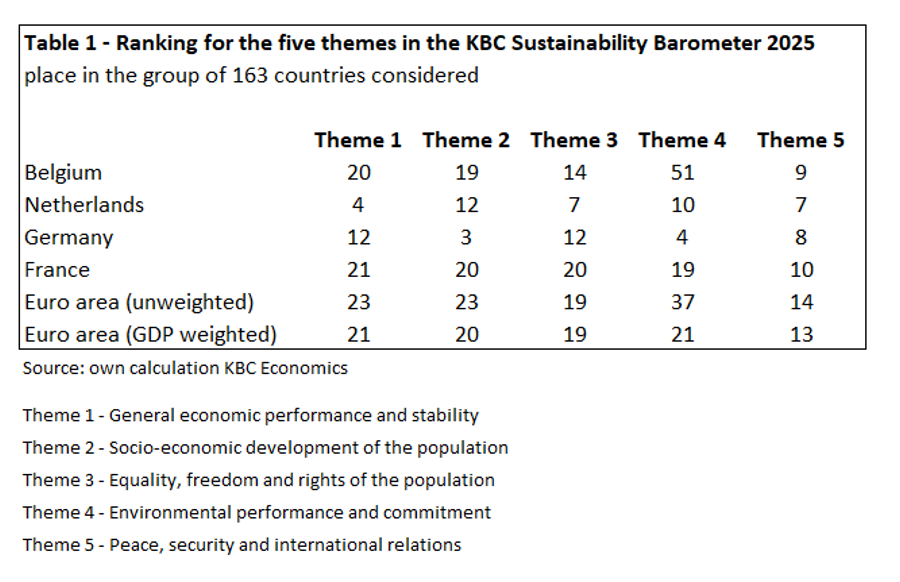
Table 1 shows the rankings in the latest update for the five sustainability themes. Belgium’s rank, within the group of 163 countries considered, is the highest for theme 5 (‘Peace, security and international relations’). With a 9th place, Belgium performs roughly equal to the Netherlands, Germany and France. It owes this mainly to its strong international openness, as reflected in its high score for economic, social and political globalisation. For theme 1 (‘General economic performance and stability’), 2 (‘Socio-economic development of the population’) and 3 (‘Equality, freedom and rights of the population’), Belgium’s rank is quite decent as well. The Netherlands and Germany perform better, though, while the rank of France is (slightly) behind Belgium’s. For all four themes mentioned, Belgium’s place in the ranking is better than the (unweighted as well as GDP weighted) average rank of the euro area countries (see table 1).
Unlike the other four themes, Belgium’s performance for theme 4 (‘Environmental performance and commitment’) is still relatively poor. It corresponds to a paltry 51st place in the country ranking. Nevertheless, Belgium climbed many places in this theme’s ranking, resulting in the country no longer being among the 50% worst performing countries for theme 4. The still not good performance is due to Belgium’s relatively high ecological footprint and its weak score on certain aspects of climate change. These include higher CO2 emissions and a high overall energy consumption per capita, as well as a relatively lower share of renewable energy in total energy consumption.
Belgium is not alone in scoring decent in themes 1, 2, 3 and 5, but still poorly in theme 4, especially among advanced economies. Among the top 20 ranked countries in the 2025 Sustainability Barometer, Ireland, Luxembourg, New Zealand, Australia and Japan all show a less-than-stellar performance in environmental sustainability. This relatively unfavourable situation illustrates that the challenges for the countries concerned, including Belgium, remain substantial in this area.
1 The link between sustainability issues on the one hand and economic development and political stability on the other has been amply demonstrated in the literature. See, for example, Mellios & Paget-Blanc (2006) and North et al (2008).