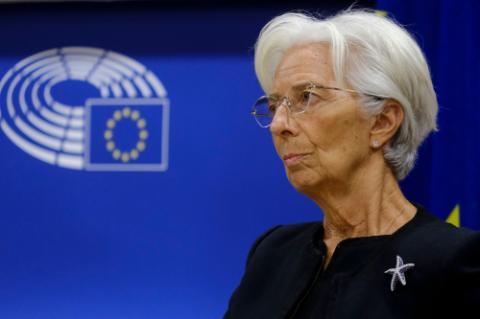

ECB takes summer break as expected


After seven interest rate cuts in a row of 25 basis points each, the ECB interrupted its easing cycle at its policy meeting on 24 July as expected. It kept its deposit rate unchanged at 2%. Consequently, its refinancing rate and its marginal lending facility rate also remain unchanged at 2.15% and 2.40% respectively. This is in line with KBC Economics' scenario and was also largely in line with market expectations. German 10-year rates consequently rose just a handful of basis points after the small probability of a rate cut this month was priced out.
As usual, ECB president Lagarde reiterated that ECB policy decisions are data-dependent, that it reassesses everything at a meeting-to-meeting basis and that the ECB does not commit to a predetermined interest rate path.
As its main reasons for not cutting its interest rate further, the ECB referred to the fact that inflation in the eurozone is right on target for the medium-term target of 2% and that market expectations are also consistent with that target. President Lagarde specifically referred to falling domestic inflationary pressures and declining wage growth. According to the central bank, the European economy remains resilient in a "challenging global environment", thanks in part to the monetary easing cycle already implemented by the ECB. In this context, the ECB refers again to exceptionally high uncertainty, caused in particular by trade conflicts.
The ECB remains quite agnostic about the impact of trade tariffs on inflation. In its June baseline scenario, it does assume that, on balance, there will rather be a disinflationary impact of the trade conflict. This assessment is mainly related to the ECB’s assumption that the EU will not take meaningful retaliatory measures in the trade conflict with the US. If it did, expected inflation would also likely be higher. On the other hand, further strengthening of the euro could lead to additional interest rate cuts by the ECB to mitigate the deflationary effect of currency strength.
'Wait and watch' mode
President Lagarde indicated that at current interest rate levels, the ECB is in a good position to wait, watch and respond to future developments and data. She made no reference that easing would resume in September. Consequently, after the press conference, market expectations assigned a higher probability to the scenario in which deposit rate bottoms out at 2%.
KBC Economics continues to assume that the ECB will cut its deposit rate by 25 basis points one last time in this interest rate cycle in the third quarter of 2025, to then 1.75%. That will be the expected bottom of this interest rate cycle. The September policy meeting is a first possible occasion, as additional information on the state of US-EU trade tariff negotiations will be available at that time. Moreover, ECB economists will come up with updated macroeconomic forecasts in September, which could provide a justification for a (final) rate cut. The main focus will be on the ECB economists' inflation forecast for 2026, which was still estimated at just 1.6% in the June update based on expectations of falling energy prices and a stronger euro.