
Retail vacancy rate in Belgium at record high

If you stroll through the shopping streets, you cannot deny it: many commercial premises are empty. Over the past two decades, the vacancy rate in Belgium has risen sharply to almost 12% at the beginning of 2026. The increased importance of online shopping is an important cause, but certainly not the only one. The development requires a multitude of solutions. In addition to making city centres more attractive and stimulating new entrepreneurship in commercial centres, efforts must also be made to eliminate the oversupply of properties on the Belgian retail market. The fact that relatively fewer commercial properties were repurposed helps to explain why the vacancy rate in Belgium remains significantly higher than in neighbouring the Netherlands (7% at the beginning of 2026).
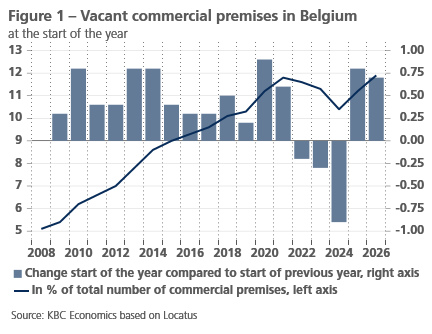
One of the most disturbing elements for a lively and attractive streetscape is the vacancy of commercial premises. According to figures from retail data collector Locatus, the vacancy rate of retail and catering properties in Belgium has increased sharply in recent decades. Between the beginning of 2008 and the beginning of 2021, it rose from 5.1% to 11.8%. After several years of decline in the vacancy rate, the increase continued to 11.9% at the beginning of 2026, the highest level since records started in 2008 (see figure 1). In absolute numbers, this concerns about 23,000 retail premises. The vacancy rate is not only increasing, but is also becoming more structural in nature. At the beginning of 2026, 32% had been vacant for more than three years, 20% for more than five years. This mainly concerns smaller retail businesses in the centres of smaller and medium-sized cities, although many buildings are also empty in larger shopping cities. The strongest increase in recent years has been mainly in Flanders. The vacancy rate has been below the national figure since 2012, but that difference has disappeared in 2025, with an increase of 10.8% to 11.9%. In Wallonia, the vacancy rate fell in 2025.
Causes
The increasing vacancy rate has several causes. In the first place, it is related to trends that have been going on for some time and are related to changed buying behaviour and new store concepts. The best known are the fast-growing popularity of online shopping (sofa shopping) and the rise of shopping centres and retail outlets outside city centres and municipalities. People are also spending less and less of their budget on fashion and expensive items (and more on trips, travel, festivals,...), which is reflected in the rise of cheap chains such as Primark and Action. In addition, economies of scale in retail also play a role, with the mostly older buildings in the centre no longer meeting the contemporary requirements of businesses. Furthermore, vacancy often has a catalytic domino effect, whereby a long-term vacant building can cause more vacancy in the neighbourhood, especially when this is accompanied by neglect (broken window syndrome). In this way, an entire neighbourhood can end up in a downward spiral. The lower attractiveness reduces the number of passers-by, which is particularly detrimental for shops that live on impulse purchases.
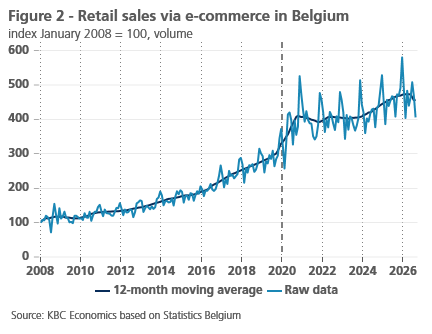
The increased vacancy rate is also related to the successive economic crises that have occurred in recent decades, starting with the banking and sovereign debt crisis in 2008-2012. The pandemic led to a peak in vacancy rates in 2021, although the impact was still relatively minor against the background of the prolonged closure of all catering establishments and non-essential shops and a sharp expansion of e-commerce during that period (see figure 2). The massive government support then ensured that many businesses were able to survive the difficult period. Also striking is the temporary decrease in the vacancy rate during the energy crisis following Russia's invasion of Ukraine. In addition to another package of support measures, this decrease could be explained by a core-strengthening policy. For example, many cities and municipalities introduced a vacancy levy and more and more retail spaces were converted into homes or offices. The falling vacancy rate was therefore partly facilitated by a decrease in the total number of commercial premises.
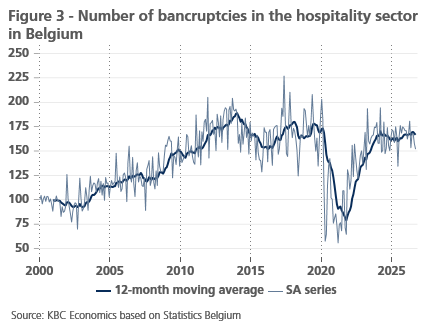
The fact that vacancy rates have increased again in 2024 and 2025 and are becoming more structural is related to the weak economic climate that gave rise to an increasing number of bankruptcies. In addition to the bankruptcy of many large retail chains (Esprit, Scotch & Soda, Blokker, Bristol, Carpetright,...), the bankruptcy figures in the hospitality sector stand out in particular (see figure 3). A shrinking hospitality sector was therefore the main cause of the additional vacancy rate in 2025. According to Locatus, of the ten sectors where the most vacancy were added in 2025, six fall under the hospitality sector. The aftermath of the successive crises is probably at play here: the disappearance of government support in combination with higher food prices and wage costs caused more and more catering operators to end up in difficulty. In addition to the cyclical explanation, the rising vacancy rate can also be explained by the rise of digital banking. This has caused the number of bank branches to decrease sharply in recent years, although premises with so-called CASH points (the new network of ATMs in Belgium) have also been added.
Dealing with vacancy
A certain amount of vacancy is not bad in itself, on the contrary. Short-term frictional vacancy (estimated at about 2 to 3%) is necessary because it provides the supply that enables movement and innovation in the retail market. In addition, vacant buildings offer space for renovation and the redevelopment of neighbourhoods where there is a need for new functions with social or economic impact (e.g. housing, offices, culture, sports,...). Vacancy only becomes problematic when it becomes increasingly structural and several buildings at a certain location are not given a (re)purpose for a long time. That is a situation that is currently occurring.
The solution to the problem is not easy and requires a multitude of answers. Many cities and municipalities are already making a lot of efforts in many areas, with varying degrees of success. For example, it is important to create a sufficiently attractive environment in city and municipal centres, in which the interweaving of the functions of living, working, shopping and relaxing provides a favourable habitat for thriving shopping streets. This includes the redesign and beautification of commercial centres and streets in such a way that the atmosphere and experience, as well as accessibility by various modes of transport, improve. In addition, specific support measures are often needed: vacancy fines, establishment premiums, limiting peripheral large-scale retail locations and linting, good city marketing, responsible relaxation of urban planning regulations,... All this requires solid planning and a sustained policy over several years. If necessary, temporary solutions are needed (e.g. pop-up stores, stickering of empty buildings, use by adjacent traders or local artists,...) to avoid reaching the tipping point after which the vacancy rate spreads rapidly (according to American research, this point is about 6% vacancy).
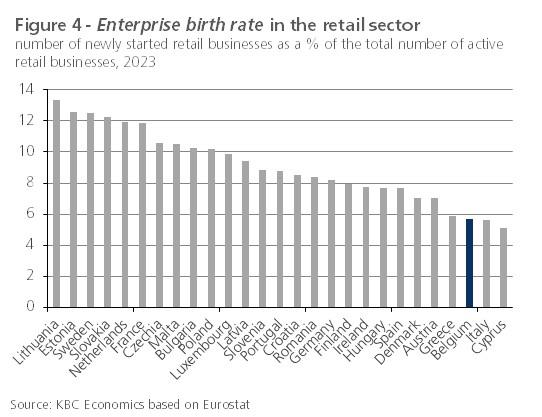
It is also necessary to stimulate new entrepreneurship in commercial centres. There is still a shortage of newcomers in Belgium who are interested in opening a business. The lack of initiative is partly due to the generally weak entrepreneurial culture in Belgium, with relatively few start-ups compared to many other European countries. According to Eurostat figures, the number of newly started retail businesses as a percentage of the total number of active retail businesses (the so-called enterprise birth rate) in Belgium in 2023 was only 5.8%, compared to 8.8% in the EU as a whole. Only Italy and Cyprus score a lower figure (see figure 4). Incidentally, (new) traders must also pay sufficient attention to innovative concepts and revenue models (e.g. experience shops), in order to keep the risk of failure (and therefore vacancy) as low as possible. Related to this is also having an eye for sufficient profitability and professional management.
Although new starters in the retail sector are of course welcome, care must also be taken to ensure that there is no oversupply of shops. In Belgium, too many new retail premises are often built in scattered and less suitable places, which on balance are not needed and therefore have little chance of success. According to Locatus, the retail density (number of outlets per 1000 inhabitants) in Belgium is one and a half times higher than in the neighbouring country of the Netherlands. On balance, relatively more retail properties have disappeared or changed function in the Netherlands over the past decade, which means that the vacancy rate is significantly lower than in Belgium (7% at the beginning of 2026). This means that certain commercial properties may be better off disappearing from the stock and having to be repurposed more quickly.