
Belgium - Economic update June 2019
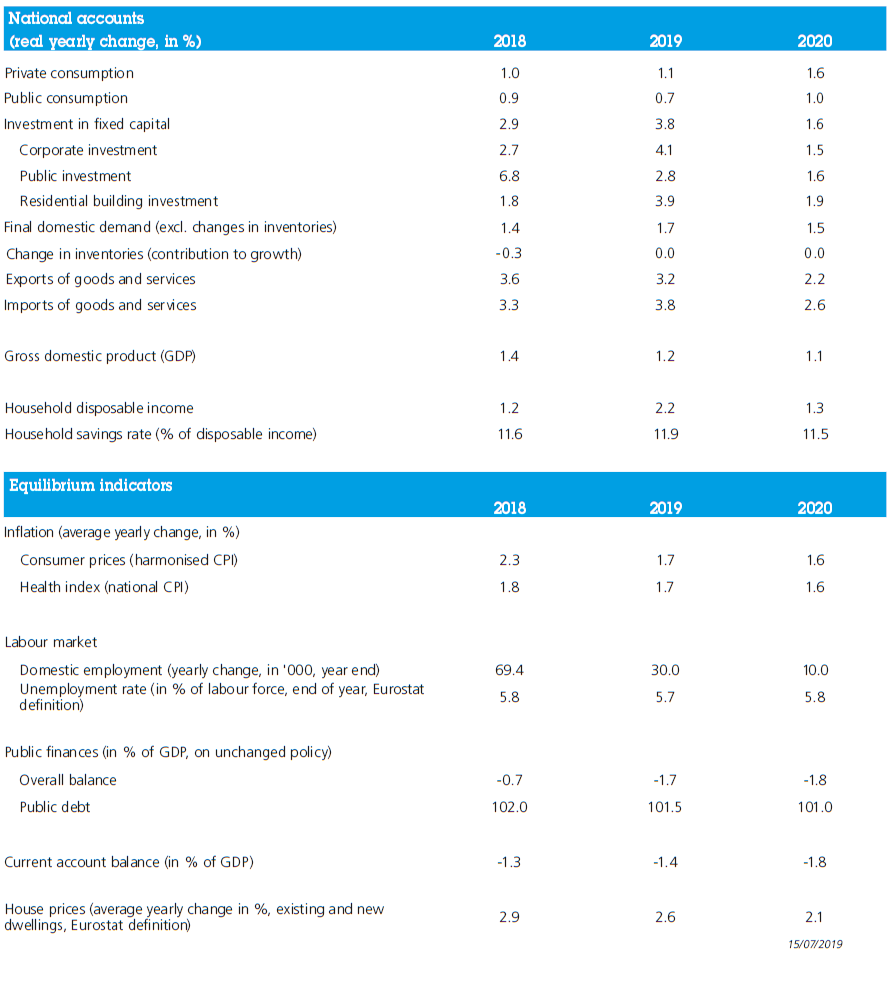
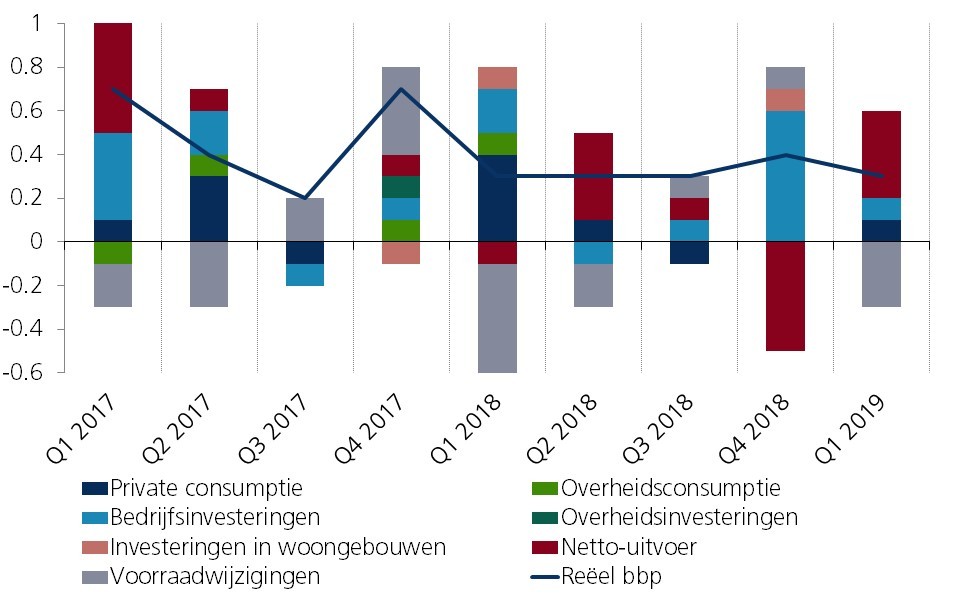
The preliminary estimate of Belgium’s Q1 2019 real GDP growth was revised higher from 0.2% to 0.3%, making the start of the year slightly better than initially expected. Still, growth in Q1 edged down marginally from the 0.4% growth figure in Q4 2018. This contrasts with GDP growth in the euro area, which rebounded in Q1. Belgian quarter-on-quarter growth in the first quarter was driven by both final domestic demand (i.e. excluding inventories) and net exports. Their respective contribution to GDP growth was 0.2 and 0.4 of a percentage point. Consumption expenditure, investment in housing as well as corporate investment picked up. Exports rose as well, while imports dropped back slightly.
Inventory formation affected quarter-on-quarter growth in Q1 substantially, with a negative contribution of 0.3 of a percentage point (figure BE1). In the past, the high volatility of inventory movements often resulted in a substantial impact on quarter-on-quarter GDP growth, despite the small share accounted for by inventory formation in GDP. This is partly due to the fact that what we refer to as inventory formation is actually an adjustment variable. In practice, alongside inventory movements, this also comprises statistical discrepancies, which for the most part cannot be explained logically. That’s why in our projections the growth contribution of changes in inventories is always set at zero.
Figure BE1 – Contribution to Belgian real GDP growth (quarter-on-quarter, in percentage points)
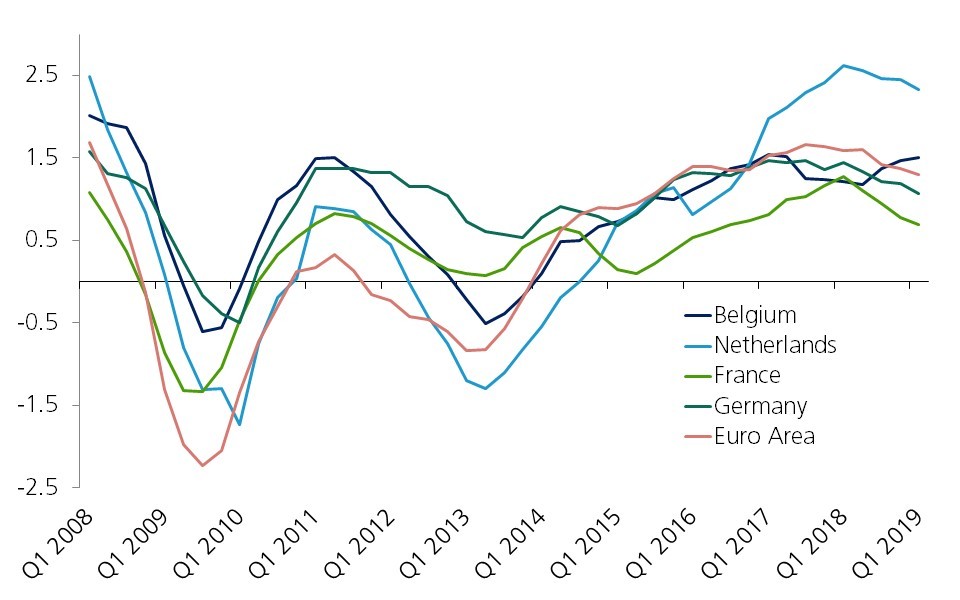
In Q1 domestic employment was up by 0.4% on the previous quarter. This points to continuing dynamic job creation. In fact, employment growth in Belgium has been accelerating again on an annual basis in recent quarters (figure BE2). This contrasts to the downward development seen in the euro area and in Belgium’s neighbouring countries in particular. On the other hand, Belgium’s (harmonised) unemployment rate has been stable since the summer of 2018, at around 5.7%, while in the euro area the rate has continued to decline. Likely, the job creation in Belgium corresponds to the filling of existing vacancies, while the dynamic of newly available vacancies has clearly weakened since the final months of 2018. The latter suggests that job creation will abate in the coming quarters.
Figure BE2 – Total domestic employment (year-on-year change, in %)
No scenario change
There are no clear signals of a strong pickup nor a collapse of Belgian activity growth in the near term. So, quarter-on-quarter growth of real GDP will likely remain weak at (or close to) 0.3% in the quarters ahead. Sentiment indicators of late have been consistent with such a scenario. Confidence of businesses, although deteriorating, still remains above its long-term average. The NBB business barometer worsened slightly in May, following a sharper drop a month earlier. The decline was seen in all sectors, except for the building industry where the previous month’s loss was reversed, mainly as a result of a rise in orders taken. This indicates that construction is still performing well, in particular in relation to the declining trend seen in the manufacturing industry.
Consumer confidence firmed up again a bit in May and is currently close to average. The indicator remained quite stable since the beginning of the year, after a clear dive as of December last year. Consumers’ fears of a rise in unemployment showed a negative trend since end 2018, but have subsided considerably in May. The fundamentals for private consumption growth remain quite favourable. Increases in households’ purchasing power will support private consumption growth this and next year, which should compensate for the expected gradual normalisation of the corporate investment cycle and the negative growth contribution of net exports.
Forecasts