

Moving beyond the Baseline in Uncertain Times: Towards a Scenario Synthesis Approach

- Read the publication below or click here to open the PDF.

“Uncertainty is not just a pervasive feature of the monetary policy landscape; it is the defining characteristic of that landscape.” 1
(Alan Greenspan, 2004)
Economic forecasting has never been easy. But the nature of the challenge is changing, and Greenspan’s words resonate with force in today’s global economic context. In recent years, the global economy has undergone profound structural transformations and a succession of exceptional shocks. The pandemic, trade tensions, the inflation surge fueled by energy and geopolitical pressures, and the rapid expansion of artificial intelligence have complicated decision-making for policymakers, financial intermediaries, households and firms.
Uncertainty is not merely something economists observe around their forecasts. It is itself an economic force. When households and firms become less confident about the outlook, they may postpone consumption and investment decisions, e.g. by increasing precautionary savings or revising their expectations about the economic outlook. These responses can, in turn, amplify or dampen fluctuations over the business cycle, shaping the ultimate effects of the original shock. Figure 1 depicts alternative empirical measures of uncertainty and their evolution through time. Although uncertainty is not directly observable and can be conceived and measured in different ways, option-implied volatility (e.g. VIX), surveys (e.g. SPF forecasts dispersion), news coverage (EPU) or statistical models can be used. As Figure 1 illustrates, these indicators capture different dimensions of economic uncertainty but generally rise during economic distress. While heightened uncertainty is often associated with economic downturns, the direction of causality remains an open empirical question.
Figure 1: Uncertainty measures over time.
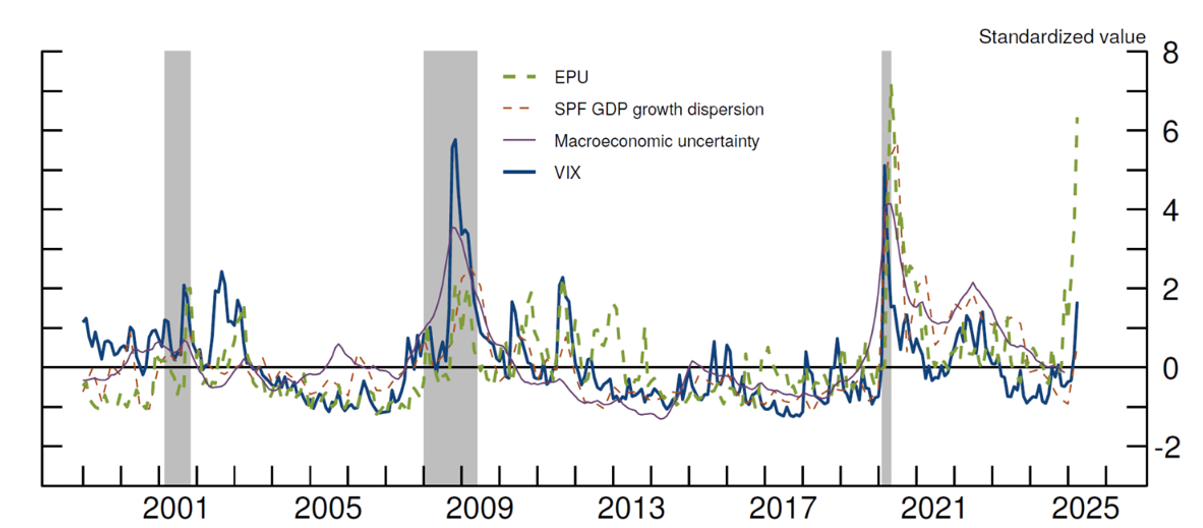
Note. All measures are standardized to have a mean of zero and a standard deviation of one. EPU denotes the Economic Policy Uncertainty Index; SPF GDP growth dispersion measures disagreement among professional forecasters; macroeconomic uncertainty is based on Jurado, Ludvigson, and Ng (2015); and the VIX measures expected stock-market volatility. Shaded areas indicate US recessions. Source: Taken from Bauer et al. (2025, Figure 2).
This interaction between uncertainty, behaviour and the business cycle also creates a deeper modelling challenge. From a modelling perspective, it widens the range of possible economic outcomes and makes it harder to determine which shocks matter most, how they propagate through the economy and whether existing models adequately capture the relevant transmission mechanisms. The problem, therefore, is not only that the future is uncertain. It is that the economy itself may behave differently from what our usual models assume.
In other words, uncertainty may concern not only the size or probability of future shocks, but also the mechanisms through which they affect the economy and the models used to represent them.
Under this deeper form of uncertainty, the mechanisms themselves become uncertain. The same energy, financial or technological shock can produce very different outcomes, as its transmission to the economy is endogenous to the responses of firms, households, central banks and the financial sector. The recent energy shock offers a clear illustration. Its pass-through to inflation depends on the extent to which firms absorb higher production costs in their profit margins and wages adjust to past inflation. The central bank’s response adds another layer of uncertainty: policymakers may look through the initial inflationary impulse or tighten policy more timely or forcefully, at a greater cost to output. The ultimate economic impact therefore depends not only on the size of the initial shock, but also on the transmission channels and policy responses that shape its propagation. Economists have historically studied these different dimensions of uncertainty quantitatively through two distinct but complementary approaches: scenario analysis and probabilistic forecasting.
The first approach is scenario analysis. Rather than trying to summarize every possible future, a scenario asks what would happen if a specific risk materialized. What if financial conditions tightened sharply? What if trade fragmentation weakened investment? What if artificial intelligence raised productivity more rapidly than expected? By tracing the relevant transmission channels, scenarios transform abstract risks into coherent economic narratives. They are intuitive and interpretable, explaining why output, inflation, interest rates or unemployment might depart from the baseline. While scenario analysis is useful from a broader communication perspective, this narrative clarity comes at a cost. A scenario can show how a financial recession might unfold without indicating how much weight should be attached to it relative to other possible outcomes. Nor does the existence of several scenarios tell us whether they collectively capture the full range of risks surrounding the outlook. A set of carefully constructed narratives may still omit an important vulnerability, overrepresent similar outcomes or devote too much attention to risks that are economically interesting but quantitatively marginal.
The second approach relies on probabilistic forecasting, which approaches uncertainty from the opposite direction. Indeed, instead of examining one particular event at a time, it seeks to describe the full range of possible outcomes around a forecast. This range may be relatively narrow or broad, symmetric or asymmetric, and it may contain particularly large downside or upside risks. Fan charts, survey distributions and more recent Growth-at-risk models all belong to this tradition. Unlike scenarios, these tools quantify risks surrounding the economic state, but this statistical richness does not always translate into a clear economic narrative. A predictive distribution may reveal that downside risks have intensified, but it does not necessarily explain why. The deterioration could reflect a financial contraction, an external-demand shock, tighter monetary transmission or an entirely different mechanism. The distribution measures the shape of the risk, while often remaining relatively silent about the narrative behind it. Conceptually, the two approaches represent two sides of the same coin.
In practice, institutions like the Fed or the ECB increasingly use both approaches. At the Fed, staff prepare alternative scenarios for FOMC deliberations, an exercise ex-Chair Powell described as “on of the best things” the staff does2 Policymakers also talk about scenarios in public. Vice Chair for supervision Bowman recently described a faster unwinding of the Middle East as one scenario she could envision, without saying how likely she thought it was.3 The probabilities come separately, notably through the uncertainty and balance of risks assessments in the Summary of Economic Projections.4 The ECB similarly combines scenarios5 with fan charts, but, as Lane notes, fan charts “do not explain which risks might hit the economy”6 highlighting the gap between probabilistic assessments and economic narratives. Therefore, scenarios and probabilistic measures often coexist without being formally connected. Scenarios explain how risks could materialize, while predictive distributions show how those risks are distributed around the baseline. What remains unclear is how much of the broader risk distribution can be attributed to each narrative. The challenge is therefore not to choose between the two approaches, but to bridge them by connecting economic narratives with probabilistic assessments of risk.
Figure 2: An illustrative example of the Scenario Synthesis framework.
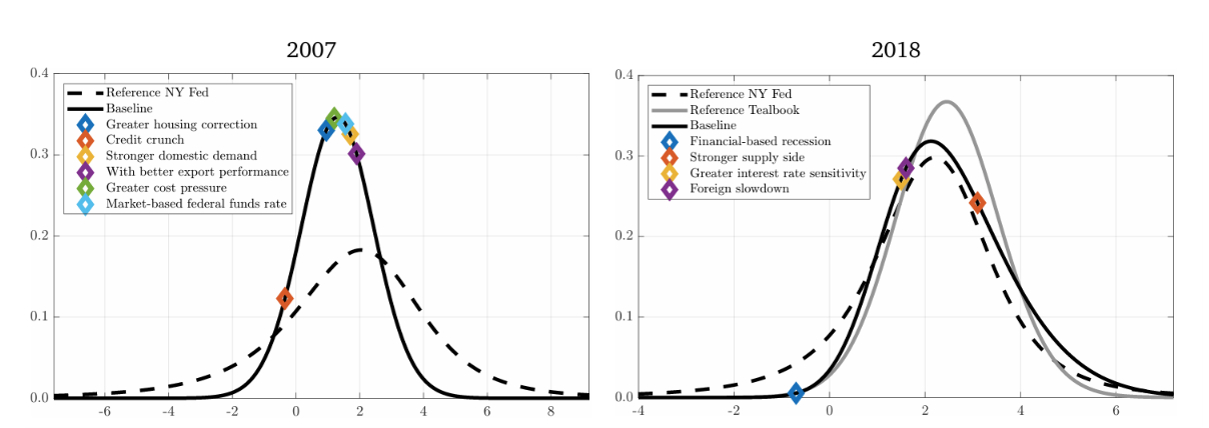
Note: The figure compares one-year-ahead US real GDP growth forecasts prepared for the December 2007 and December 2018 FOMC meetings. The solid black curve shows the baseline forecast distribution, while the dashed black curve shows the reference distribution from the New York Fed’s Outlook-at-Risk model. In the 2018 panel, the grey curve provides an additional reference distribution from the Federal Reserve’s Tealbook. The coloured diamonds represent the baseline and alternative scenario forecasts. The figure presents the inputs to Scenario Synthesis: the framework assigns weights to these forecasts so that their mixture approximates the reference distribution. Source: From Scenario Synthesis and Macroeconomic Risk (Figure 1), by T. Adrian, D. Giannone, M. Luciani, and M. West, 2025, IMF Working Paper No. 25/105, International Monetary Fund.
Scenario Synthesis offers such a bridge. The framework proposed by Adrian et al. (2025) combines both a baseline with alternative scenarios and determines which mixture most closely matches a reference distribution of possible outcomes. The reference distribution quantifies the risk profile, while the scenarios give it economic meaning. Figure 2 provides a more concrete visualization of these inputs: the curves show the baseline and reference distributions, while the coloured diamonds represent the baseline and alternative scenario forecasts. The framework enables us to assign weights to these alternative scenarios so that their mixture approximates the reference distribution as closely as possible. The resulting weights indicate the relative importance of each narrative but should not automatically be interpreted as probabilities. A high weight does not necessarily mean that a scenario will occur as described, but that it captures an important part of the reference risk profile relative to the other narratives considered. Weights are therefore measures of relative importance rather than the likelihood of a particular outcome. This distinction clarifies, rather than diminishes, the framework’s contribution.
The value of Scenario Synthesis lies not in eliminating uncertainty, but in organizing it within a disciplined quantitative framework. It can reveal whether a scenario set adequately covers the range of plausible outcomes, whether some scenarios are redundant, and whether important tail risks remain unaddressed. In this way, the framework can improve both the evaluation and design of scenarios. It can also structure institutional disagreement by expressing competing views about shocks, transmission mechanisms or models through alternative narratives and confronting them with a common assessment of risk. For central banks, this can support more transparent communication about the economic outlook and the conditions under which policy might change. Although rooted in central-bank practice, its potential applications extend considerably further.
At KBC Economics, our goal is to translate uncertain economic developments into coherent narratives, quantitative projections and decision-relevant risks. Synthesis can connect alternative narratives with quantitative evidence on the broader range of possible outcomes. Its main contribution therefore lies in communication and governance rather than in mechanical forecast production. For KBC, this implies complementing existing forecasting and scenario-design processes by testing the consistency between expert judgement and statistical assessments of macroeconomic risk.
This approach supports a richer form of risk communication. Instead of simply listing upside and downside risks around a central forecast, economists could identify which narratives explain the main features of the risk distribution and where uncertainty remains. The aim is not to create an illusion of precision, but to make judgement more explicit, comparable and transparent. More broadly, this reflects a shift in macroeconomic forecasting from predicting a single outcome to assessing a range of plausible futures.
When the economy may no longer behave as familiar models assume, a single forecast cannot capture the full range of possibilities. Macroeconomic analysis must therefore move beyond forecasting one future towards assessing the sensitivity of several plausible futures. Scenario analysis gives these futures economic meaning, while probabilistic forecasting quantifies their range and balance. By connecting the two, Scenario Synthesis offers a more disciplined way to understand, organize and communicate macroeconomic risks. It does not make an uncertain landscape predictable, but it can make that landscape easier to navigate.
1 See Greenspan (2004), Risk and Uncertainty in Monetary Policy.
2 See Federal Reserve Board (2025), Transcript of Chair Powell’s Press Conference, 29 January.
3 See Bowman (2026), The U.S. Economy and Considerations for Monetary Policy, 10 November.
4 See Federal Reserve Board (2026), Monetary Policy Report, July, Summary of Economic Projections.
5 For a recent discussion of alternative scenarios on the energy shock, see Lane (2026), Diagnostic Challenges for ECB Monetary Policy, 5 October.
6 See Lane (2024), Monetary Policy under Uncertainty, 25 November.
References
Adrian, T., Giannone, D., Luciani, M., & West, M. (2025). Scenario synthesis and macroeconomic risk (IMF Working Paper No. 25/105). International Monetary Fund.
Bauer, M., Berge, T., Fiori, G., Loria, F., & Zhong, M. (2025). Accounting for uncertainty and risks in monetary policy (Finance and Economics Discussion Series 2025-073). Board of Governors of the Federal Reserve System.
Board of Governors of the Federal Reserve System. (2025, January 29). Transcript of Chair Powell’s press conference. Federal Reserve transcript
Board of Governors of the Federal Reserve System. (2026, July 10). Monetary policy report. Federal Reserve Monetary Policy Report [federalreserve.gov]
Bowman, M. W. (2026, November 10). The U.S. economy and considerations for monetary policy. Board of Governors of the Federal Reserve System. Speech by Vice Chair for Supervision Bowman on the U.S. economy and considerations for monetary policy
Greenspan, A. (2004). Remarks by Chairman Alan Greenspan At the Meetings of the American Economic Association On Risk and Uncertainty in Monetary Policy.
Jurado, K., Ludvigson, S. C., & Ng, S. (2015). Measuring uncertainty. American Economic Review, 105(3), 1177-1216.
Lane, P. R. (2024, November 25). Monetary policy under uncertainty. European Central Bank. Lane speech on monetary policy under uncertainty
Lane, P. R. (2026, October 5). Diagnostic challenges for ECB monetary policy. European Central Bank. Lane speech on ECB diagnostic challenges [ecb.europa.eu]