

EU housing market boom continued in Q4 2025

Click here to read the PDF

Prices on the European housing market continued to rise in the last quarter of 2025, according to new Eurostat figures. The quarterly rate of increase in prices did slacken, from 1.6% to 0.8%, but the annual rate of increase remained close to that in previous quarters. Viewed over the full year, house prices in the EU rose 5.5% in 2025 from a year earlier, stronger than in 2024 (+3.4%). As in previous quarters, there were significant differences between member states in Q4. There were three countries (one less than in Q3) with a qoq price decrease, albeit limited, (France, Finland and Estonia) and five countries (also one less than in Q3) with a qoq price increase of more than 3% (Slovenia, Hungary, Portugal, Croatia and Slovakia). In Belgium, quarterly dynamics weakened in Q4 (+0.5%), after having rebounded quite a bit in Q3 (+2.4%).
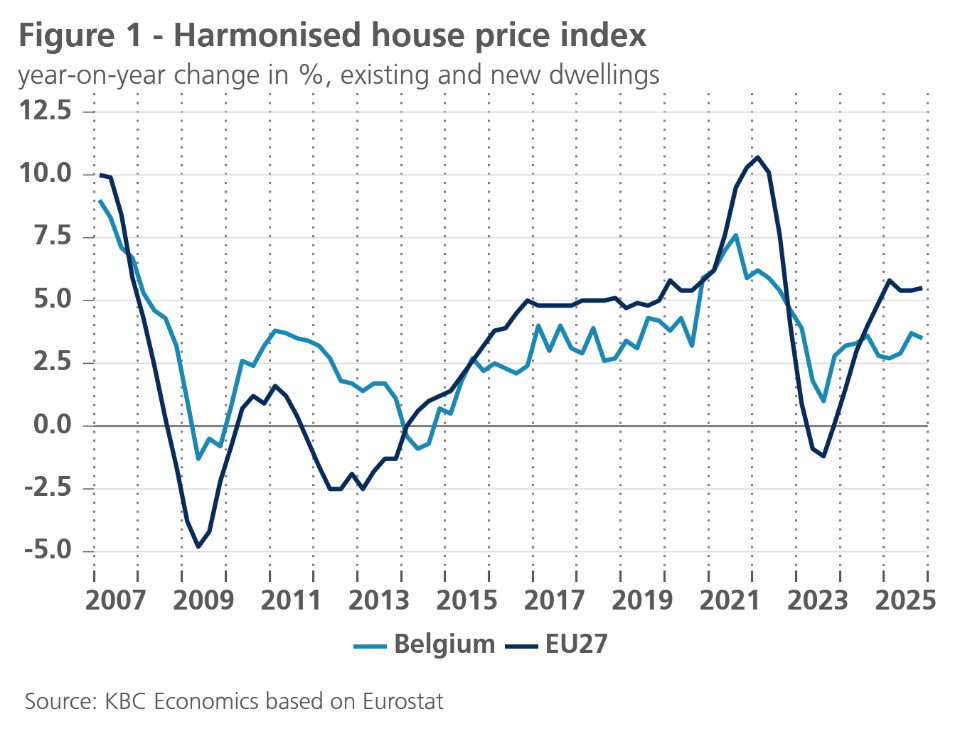
Eurostat recently published house price figures for Q4 2025. This is the harmonised house price index for EU member states, which takes into account both existing and new homes and corrects for price changes due to changes in the characteristics of the property sold. In the EU as a whole, house prices rose 0.8% quarter-on-quarter in Q4 2025. This is a slowdown compared to the rate of increase in Q1 (+1.4%) and Q2 and Q3 (both +1.6%). Compared to the same quarter a year earlier, EU house prices were 5.5% higher in Q4 2025. The year-on-year increase momentum thus remained close to the figures in previous quarters (5.8% in Q1 and 5.4% in both Q2 and Q3) (see figure 1).
Country differences
In Q4 2025, there were three countries (France, Finland and Estonia) where house prices fell compared to the previous quarter (see figure 2). In the three previous quarters, there were four. The price decline in the three countries mentioned was limited to less than 1%, though. Especially in Finland, the housing market continued to face weakness. In Q4 2025, the price level in the country was still 14.1% below the previous peak in 2022. By comparison, in Luxembourg (+0.4% in Q4) and Germany (+0.1% in Q4), which also faced a sharp correction earlier and where the market is now slowly recovering, the price level in Q4 2025 was still 14.5% and 8.2% below the previous peak in 2022, respectively. Across the EU, it was 9.2% above again in Q4 2025.
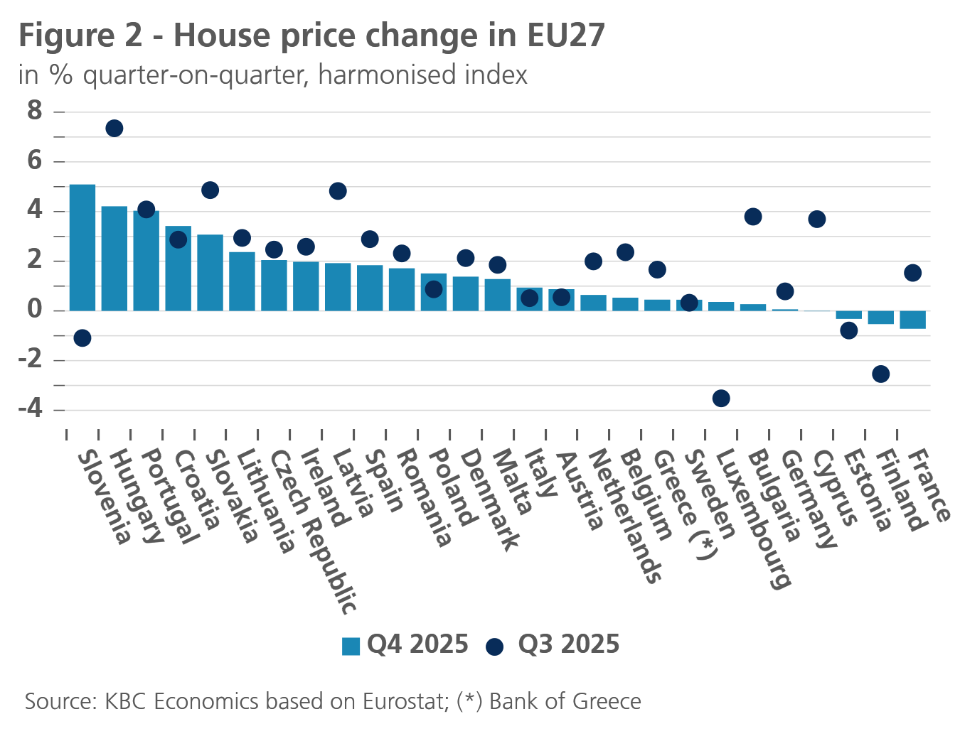
In five EU countries, quarterly house price growth exceeded 3% in Q4 2025. These are slightly fewer countries than in the previous three quarters. Slovenia (+5.1%) saw the strongest quarterly increase in Q4, but it followed a volatile path with also price declines in some of the previous quarters. The other four countries, Hungary (+4.2%), Portugal (+4.0%), Croatia (+3.4%) and Slovakia (+3.1%), already saw particularly strong qoq price dynamics in previous quarters. In ten countries, including Belgium, house prices rose rather modestly, by less than 1%. In Belgium, the 0.5% qoq price rise in Q4 followed a strong increase in Q3 (+2.4%) and a slight correction in Q2 (-0.1%).
Compared to the same quarter a year earlier, only one EU country, Finland (-3.1%), showed a decline in house prices in Q4 2025. The highest annual price increase was recorded in Hungary (+21.2%) and Portugal (+18.9%). Seven other eastern and southern European countries also recorded double-digit yoy price increases in Q4: Croatia (+16.1%), Spain (+12.9%), Slovakia (+12.8%), Bulgaria (+12.6%), Latvia (+11.0%), Lithuania (+10.8%) and the Czech Republic (+10.4%). In Belgium, house prices in Q4 2025 were 3.5% higher than a year earlier.
Viewed over the whole year, prices across the EU increased 5.5% in 2025 compared to a year earlier, stronger than the increase in 2024 (+3.4%). Only one country, Finland (-2.5%), saw house prices fall, after already falling by 6.2% and 3.1% in 2023 and 2024 respectively. There were sixteen countries where prices increased by more than 5% in 2025, with seven countries even recording a price increase of more than 10%: Hungary (+18.3%), Portugal (+17.6%), Bulgaria (+14.6%), Croatia (+14.1%), Spain (+12.7%), Slovakia (+12.4%) and the Czech Republic (+10.4%). In Belgium, the price increase in 2025 was 3.2%, which is the same percentage as in 2024. For the EU as a whole, it is notable that in 2025, prices for new homes stopped increasing more than those for existing ones. While prices for existing homes fell by 1.5% in 2023, those of new ones continued to rise by 5.0% that year. In 2024, the prices of existing and new homes rose by 2.5% and 6.8% respectively, while in 2025 price rises were at 5.7% and 4.7% respectively. In three countries (Denmark, Hungary and Slovenia), the difference in price increase between existing and new homes exceeded 5 percentage points in 2025.
Belgian market
In Belgium, prices in Q4 2025 were 9.0% above the previous peak level of Q3 2022, when the cooling of the housing market began at the time. In the EU as a whole, it was 9.2%. Compared to the EU, Belgium experienced a milder cooling on the one hand and a smaller rebound in prices over the past two years on the other (see figure 1). Prices for the segments of existing and new homes ran fairly parallel in Belgium over the cited period, with net increases of 8.3% and 12.6% respectively (see figure 3). In the EU, those figures diverged more, at 7.0% and 18.5% respectively. In Q4 2025, prices of existing and new homes in Belgium rose by 0.3% and 1.2% respectively compared to the previous quarter (0.7% and 1.4% respectively in the EU).
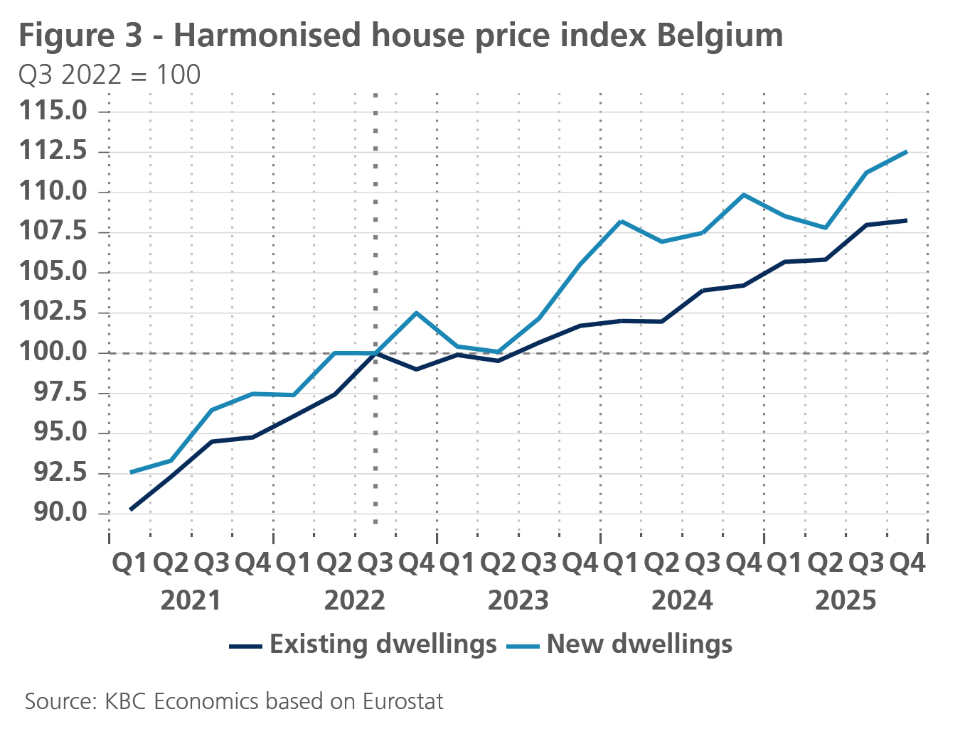
The figure for Q4 2025 does not materially change our view of Belgian real estate. For housing (existing and new) as a whole, we forecast a price rise in Belgium of 3.3% in 2026, broadly similar to the rise in 2024 and 2025. With overall inflation also above 3%, our house price forecast for 2026 implies virtually zero growth in real house prices (i.e. adjusted for HICP inflation), as was the case in 2025. In such scenario, Belgian real estate will not become overvalued again. Risks of solid overvaluation do exist in other EU countries, though, given their steep price growth over the past decade. Comparing Q4 2025 with Q1 2015, prices more than quadrupled in Hungary (+317%) and more than doubled in eleven other countries, with the biggest increases in Portugal (+189%), Lithuania (+175%), Bulgaria (+160%) and the Czech Republic (+158%).