

A worrying look at Belgium's public finances

Content table:
1. Recent developments in public finances
2. Debt ratio on an unsustainable path
3. Why too much debt is not good
Read the publication below or click here to open the PDF

In recent years, Belgian public finances have been under pressure due to successive crises. Expressed as a percentage of GDP, government debt did fall in the years after the pandemic peak, partly due to high inflation, but the persistently high primary government deficit has caused the debt ratio to rise again in recent years. On balance, public finances in Belgium deteriorated more than the EU27 average between 2019 and 2025. With unchanged policies, the deficit would increase further in the coming period due to, among other things, the ageing costs. This means that the Belgian public debt is in danger of becoming unsustainable. The government is now faced with the difficult task of making public finances healthy again. The primary aim of the consolidation is to comply with European rules, but in the long term it must also create the necessary space for new policy to meet challenges, including the ageing population, climate change and the geopolitical situation. It requires a more systematic control of structural public expenditure and a continued commitment to ambitious reforms. The latter should ensure that the efficiency of the government improves, that more people are in work and that the growth potential of the economy is strengthened.
Various bodies, including official ones such as the National Bank of Belgium and the Federal Planning Bureau, have been highlighting the worrying state of Belgium’s public finances for some time. Not only the current situation (i.e., a high structural deficit and a rising debt ratio), but also the longer-term sustainability is a major concern in the light of the various challenges facing the country. These concern not only the ageing population, but also others such as climate change, the changed geopolitical situation in Europe and the associated higher military spending or the upgrading of public infrastructure. In this research report, we take a broad look at Belgium’s public finances. Section 1 reviews its latest development and places it in a European perspective. Section 2 illustrates that finances, and the debt ratio in particular, would end up on an unsustainable path if policy remains unchanged. In section 3, we argue that such an evolution entails important financial and economic consequences and risks. Section 4 makes some considerations about the necessary restructuring of finances that the Belgian government will have to implement.
1. Recent developments in public finances
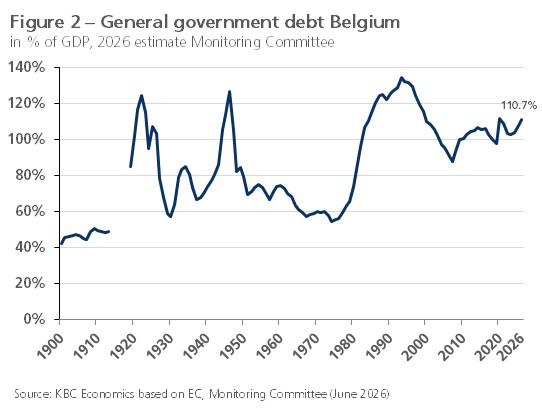
The rapid succession of crises in recent years (in particular the pandemic, the trade war and the energy crisis) have severely impacted Belgian public finances. In 2019, the general government deficit and public debt of the general government of Belgium amounted to 2.0% and 97.7% of GDP, respectively. In 2020, both peaked at 9.0% and 111.4%. In 2021-2022, the situation improved, but in recent years it has deteriorated again to a deficit and debt that in 2025 rose well above pre-pandemic levels at 5.2% and 107.9% of GDP respectively. According to the Monitoring Committee's latest estimate (published in mid-2026), the general government deficit is expected to barely improve in 2026 (5.1% of GDP) and the debt ratio is expected to rise further to 110.7% of GDP (see figures 1 and 2).
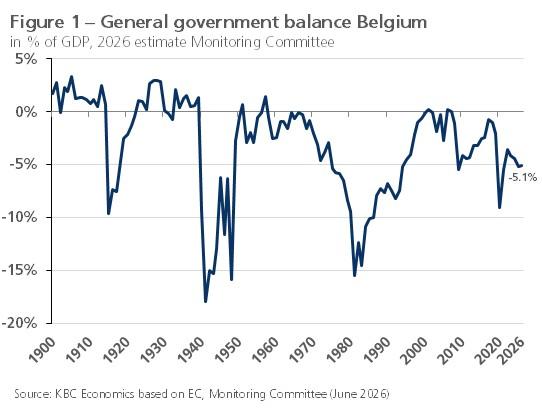
The deterioration of Belgian public finances between 2019 and 2025 was more pronounced than was the case on average in the EU27. In Belgium, the increase in deficit and debt between 2019 and 2025 amounted to 3.1 and 10.2 percentage points of GDP respectively. In the EU27 as a whole, this was 2.6 and 3.7 percentage points of GDP respectively (see figures 3 and 4). With a government deficit of 5.2% of GDP in 2025, Belgium scored the worst figure in the EU27 after two countries (Poland and Romania). The debt ratio of 107.9% of GDP was the fourth highest that year, after that of Greece, Italy and France. The fact that the deficit in Belgium increased slightly more in the period in question is partly due to the operation of the 'automatic stabilisers'. These are mechanisms built into public finances (such as the system of unemployment benefits) to mitigate fluctuations in the economic cycle without active government intervention. According to an estimate by the OECD, Belgium is one of the European countries with a rather strong automatic cushioning of the impact of shocks on the economy, which translates into government expenditure and revenue.1 However, as economic growth in Belgium held up relatively better than in the EU27 as a whole during the past crises, the difference between Belgium and the EU27 in terms of change in the cyclical component of the general government balance in the period 2019-2025 remained rather limited.
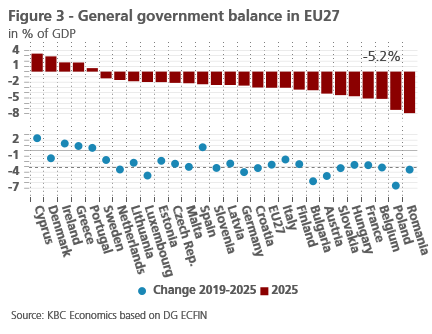
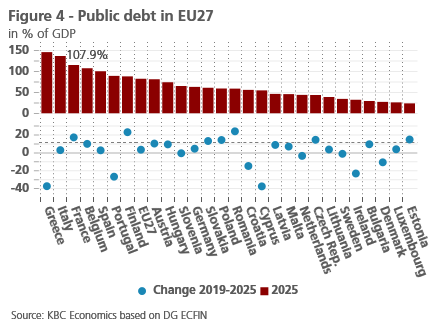
More than the impact of the economic situation, the relatively somewhat larger deterioration in Belgian public finances was due to the more expansionary fiscal policy and one-off measures. In part, it was the exceptional public support needed to address the impact of the crises (including the extension of temporary unemployment during the pandemic and energy support to households and businesses). This crisis policy has helped to ensure that Belgium has come through the past difficult period relatively well economically. The effective fiscal policy is generally measured by the change in the structural primary balance (i.e., the general government balance adjusted for cyclical influences and interest payments).2 The sharper deterioration of this balance in Belgium, compared to the EU27, points to a relatively strong discretionary policy response in Belgium over the past few years (see figures 5 and 6). The fact that the difference in deterioration of the general government balance between Belgium and the EU27 remained limited is due to the fact that interest payments on the debt increased less in Belgium than in the EU27 as a whole. In summary, of the 0.53 percentage points stronger increase in the general government deficit between 2019 and 2025 in Belgium compared to the EU27, 0.15 percentage points was due to the cyclical impact, 0.52 percentage points to the more expansionary fiscal policy and one-off measures, while the smaller increase in interest payments reduced the relative deficit deterioration by 0.14 percentage points.
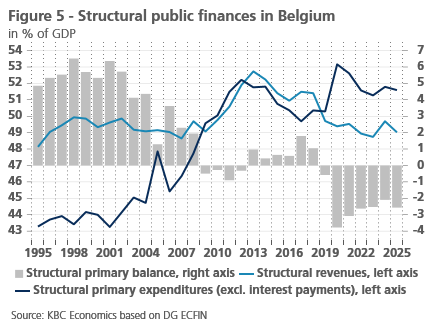
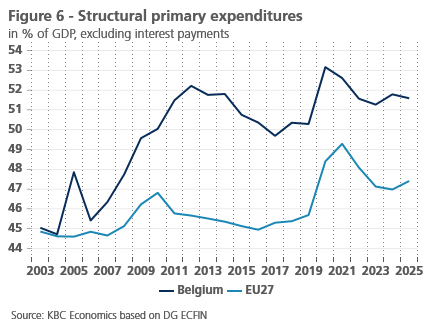
With regard to fiscal policy, the structural deterioration of finances was attributable to both an increase in structural primary government expenditure (excluding interest payments) and a decline in structural revenue (see figure 5). The higher expenditure was mainly due to the gradual implementation of the De Croo government's coalition agreement, with measures that are mainly part of social security (including the increase in many social minima, the raising of the real growth norms for health care benefits, and the sectoral care agreements). It is striking that structural revenues have started to decline earlier, since 2013, while structural expenditure has increased not only since 2019, but also on a longer-term trend relative to the EU27 (see figure 6). According to the Monitoring Committee's latest multi-year estimate (published mid-2026), the structural primary deficit of the Belgian government would initially decrease in the coming years, under a no-policy-change assumption, from 2.6% of GDP in 2025 to 1.9% in 2027, but would then rise again to 2.5% of GDP in 2030.
2. Debt ratio on an unsustainable path
In May, the European Commission estimated Belgium's public debt for 2026 at 110.5% of GDP in its spring forecast. This figure remains among the highest in Europe. In the EU27, the debt expected for 2026 is only much higher in Greece (141%), Italy (138%) and France (118%). Compared to the average in the EU27 (84.2%), the Belgian debt ratio is 26 percentage points higher. The high Belgian public debt (both in absolute terms and relative within Europe) is an old structural problem. Over the past century, the gross debt ratio has never fallen substantially or for a long time below the 60% threshold that Europe has set as a numerical target (see figure 2). Only between the mid-60s and the end of the 70s was the ratio close to that for a while. The average level of the Belgian debt ratio has been around 90% of GDP since 1920.
After peaking in 2020, Belgian debt fell for three consecutive years, giving the positive impression that the ratio had entered a downward path. However, the decline in 2021-2023 was due to the exceptionally strong nominal growth of Belgian GDP and more specifically its price component (the GDP deflator), as a result of the sharp surge in inflation following the energy crisis at the time. This was reflected in a higher denominator of the debt ratio and thus had a debt-reducing effect. In combination with the historically low implicit interest rate on government debt, the high nominal GDP growth created a so-called 'reverse snowball effect' (g > i).3 In addition, the endogenous change in debt is also determined by the size of the primary balance (i.e., the government balance excluding the interest payments on the debt). The high primary deficits continued to fuel Belgium's debt ratio in 2021-2023 (see figure 7).
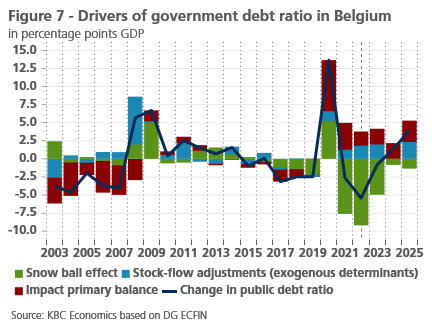
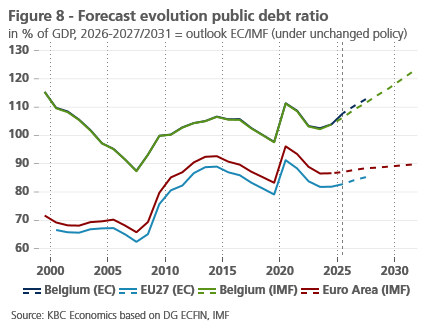
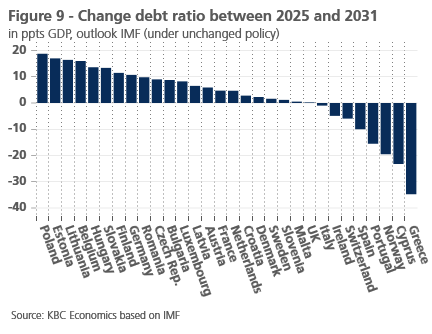
Due to lower economic growth and higher interest rates, the sharp reverse snowball effect in 2024-2025 almost wore off. With the persistent primary deficits, the debt ratio has started to rise again since 2024. This situation is worrying, as persistent deficits threaten to lead to a structural upward movement in debt dynamics. Figure 8 shows the most recent forecast of the debt ratio made by the European Commission (for 2026-2027) and the International Monetary Fund (for 2026-2031) respectively. According to the IMF forecasts, which are the most far-reaching, the Belgian government's debt (under unchanged policy) would rise to 122.3% of GDP in 2031, while in the euro area it would rise much less to 89.7% of GDP (the IMF does not forecast figures for the whole EU27). This makes Belgium one of the European countries with the strongest debt increase (in percentage points of GDP) between 2025 and 2031 (see figure 9).
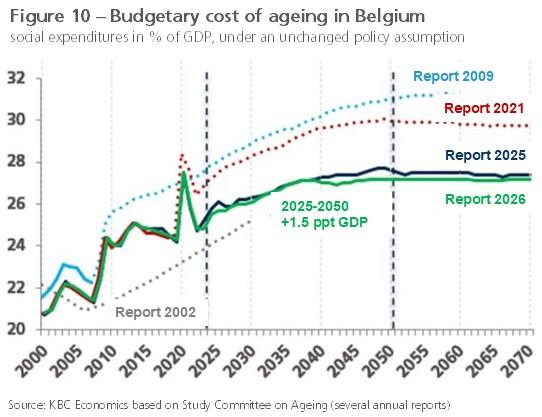
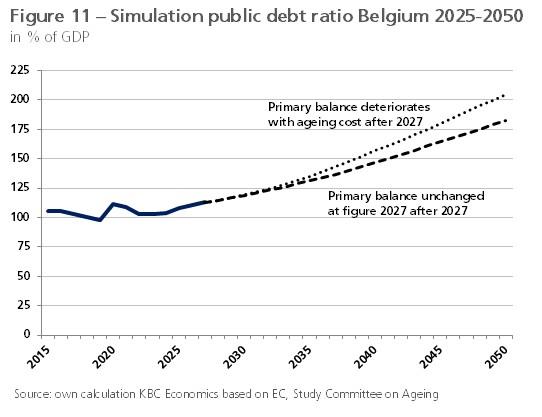
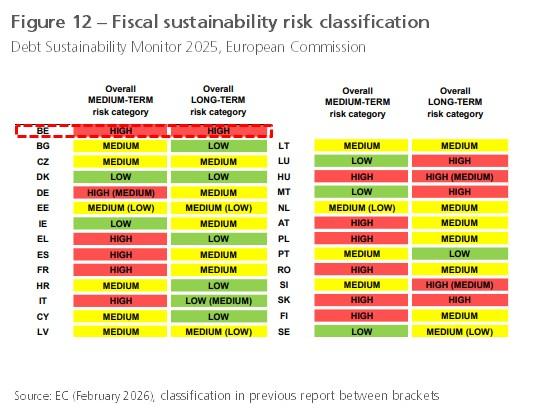
One cause of the structural deterioration of Belgian public finances is the increasing cost of the ageing of the population (mainly in pensions and health care). According to the Study Committee on Ageing (Annual Report 2026), this annual cost will increase by 1.5 percentage points of GDP in the period 2025-2050 if policy remains unchanged (see figure 10). In figure 11 we simulate the evolution of the Belgian debt ratio in the long term until 2050, assuming that the primary deficit deteriorates after 2027 to the extent of these ageing costs estimated by the Study Committee. The debt ratios for 2026 and 2027 are the European Commission's latest forecasts.4 The figure illustrates that, if policy remains unchanged, the costs of ageing would cause the Belgian debt ratio to rise sharply in the coming decades. The fact that Belgian public finances are on an unsustainable path with unchanged policy is also confirmed in the European Commission's latest Debt Sustainability Monitor (published in February 2026). Belgium and Slovakia are the only two EU countries for which the Commission has identified a high risk of unsustainable public debt in both the medium and long term (see figure 12).
3. Why too much debt is not good
Government debt is not bad in itself. It is acceptable if it makes it possible to increase the productive capacity of the economy and if the return on debt-increasing government interventions (investment in infrastructure, education, security, etc.) is greater than the costs generated by the debt (the interest costs). However, excessive debt entails significant economic risks. First of all, doubts may arise about the sustainability of the debt, more specifically about the repayment and interest payments (the so-called solvency risk). In the end, the entire financial system could fall into crisis, because banks are traditionally major buyers of government debt in which they invest part of the collected savings deposits. The adjustments required to reduce an out-of-control debt position are usually substantial and potentially dramatic for the population. The sovereign debt crisis of 2010-2011 in the euro area, and Greece in particular, is a painful illustration of this.
Specifically, high debt makes government finances vulnerable to high(er) interest rates in the long run, especially in a period of budgetary consolidation. A larger share of the revenue must then be used to take care of the interest payments, so that other expenditures, often also the more productive ones such as investments in infrastructure, are squeezed (the so-called cuckoo effect), unless the tax burden is increased. More generally, high interest payments and/or the need for consolidation imply a lower policy capacity to absorb future new shocks and challenges. Furthermore, in the event of sharply rising debt, interest rates can in turn tend to rise, which puts a brake on private investment (the so-called crowding-out effect).
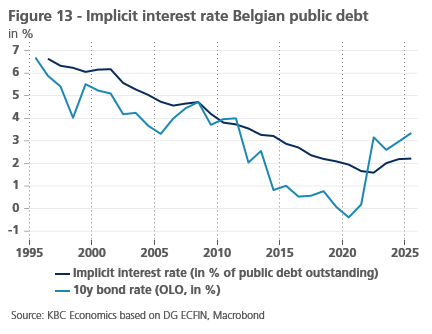
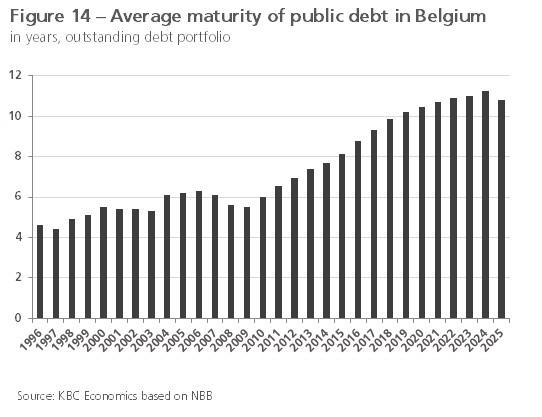
In line with the 10-year bond yields that have risen sharply since 2021, the implicit interest rate on Belgian government debt has also started to rise since 2023 (see figure 13). The extent to which this happened was somewhat mitigated by the fact that the Belgian treasury took advantage of the previous low interest rate environment to refinance the outstanding debt at very low interest rates. The average maturity of the outstanding debt portfolio increased from 5.5 years in 2009 to 11.2 years in 2024, after which it fell slightly to 10.8 years in 2025 (see figure 14). Despite the high government debt, Belgium still maintained market confidence. The yield spread of the 10-year Belgian OLO against the German Bund has remained close to 50-60 basis points in recent years. Very recently, it rose above 90 basis points, though. It is striking that Belgium's negative spread with France, which is also struggling with poor public finances, has widened already since the beginning of 2023. This implies that the perception of Belgian public finances by the financial markets remained (for the time being) better than that of the French public finances (see figure 15). Rating agencies have already lowered the credit rating of the Belgian government several times over the past two decades, though.
Finally, note that economic growth can also be negatively affected by all this. This is even more the case if citizens were to save more in anticipation of a higher future tax in order to be able to reduce the high debt (the so-called Ricardian Equivalence Theorem). However, opinions differ widely on the extent to which high public debt stifles growth.5 Some economists suggest a negative, non-linear relationship in which growth weakens as the debt ratio rises very high. Other economists question that conclusion. Their criticism concerns the causal link. It is not because a link between high debt and low growth is established that the low economic growth was caused by the high debt. Conversely, low growth may lead to high government debt, because less taxes are collected and more spending is made.
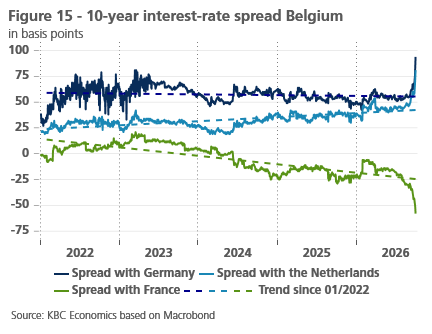
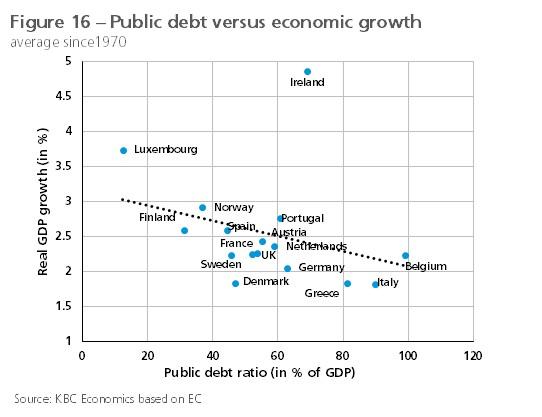
Figure 16 confirms that while there appears to be a negative relationship between debt and growth in a group of European countries over a long period of time, it is not very strong. If there is a critical threshold above which debt starts to cripple growth, it is likely to vary from country to country, depending on specific economic and institutional characteristics. Indeed, factors such as weak institutions, low competitiveness or a vulnerable banking sector contribute to determining the extent of the impact of high public debt on economic growth. After all, these factors help determine the overall financial and economic stability of the country in question. Still, Belgium often does not score badly or sometimes even well in these areas. In other words, the high level of public debt is offset by the favourable general financial situation of the Belgian economy, thanks to a relatively healthy private sector. As a result, the economy as a whole (households, businesses and government combined) is in a positive net financial position compared to the rest of the world. At the beginning of 2026, this so-called Net International Investment Position in Belgium amounted to 52% of GDP, one of the highest figures in the EU27.
Current and previous governments have implemented several reforms, including on pensions, which will improve the sustainability of public finances (especially in the somewhat longer term). Nevertheless, there is still a great need for consolidation in order to reverse the budgetary situation (also in the shorter term). More precisely, an effort of almost 8 billion euros is needed to stay in line with the European spending norm, but the government wants to build in some margin and is aiming for 10 billion euros. Since the reform of the Stability and Growth Pact, the European Commission has assessed compliance with the fiscal rules on the basis of a growth trajectory of 'net government expenditure'. In principle, this should reduce the general government deficit to below 3% of GDP by the end of the adjustment period. Belgium was granted a seven-year adjustment period, until 2031, to ensure that finances return to a sustainable path. With the activation of the flexibility clause for military spending, the situation changed. By temporarily allowing higher spending on defence without direct budgetary compensation, the new European fiscal rules can be respected while the reduction of the deficit below the 3% threshold is postponed.
This means that strict adherence to the European budget trajectory, and therefore also the planned consolidation of 10 billion euros, may not be sufficient to reduce the deficit to 3% of GDP. In this respect, it is important to put in place a coherent longer-term strategy for the consolidation of public finances. Such a strategy implies not only the restructuring necessary to comply with European rules, but also a longer-term vision of reversing the upward trend in the debt ratio. The latter is necessary in order to create space for the future to absorb new setbacks, to be able to implement new policy and to be able to meet the various challenges. The latter concern not only the ageing population, but also climate change, the changed geopolitical situation in Europe, the upgrading of public infrastructure, as well as probably others that we do not know about today. After all, the environment in which we live is becoming increasingly complex, which increases uncertainty about government policy and public finances.
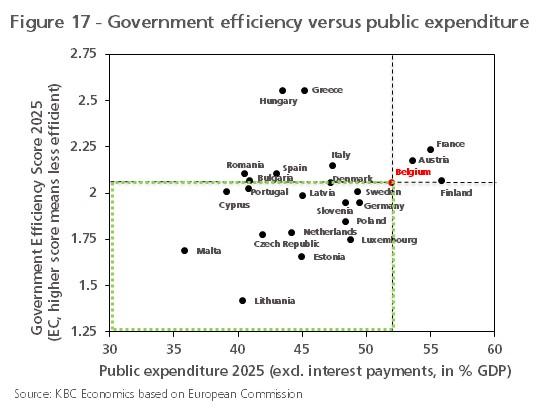
Given the already high tax burden, the restructuring should focus as much as possible on systematic control of structural government expenditure, which is currently among the highest in the EU27 (in 2025 it was only higher in Austria, France and Finland). In addition, there is still room for increasing government efficiency. After all, available indicators (e.g., the World Bank's Government Effectiveness Index and the European Commission's recently published Government Efficiency Score) indicate that the public sector in Belgium is relatively inefficient from a European perspective and that the situation in this area has even deteriorated.6 Many European countries achieve a higher (or the same) score than Belgium in terms of public efficiency despite lower structural spending (in % of GDP) (see figure 17). The relatively low efficiency in a context of high government spending, in addition to the country's institutional complexity and lack of coordination between levels of government, is linked to a lack of sharp and stable policy goals and priorities. There is a need for a more long-term vision in policy focused on what is really important socially and economically, especially in the light of the scarce budgetary resources available.
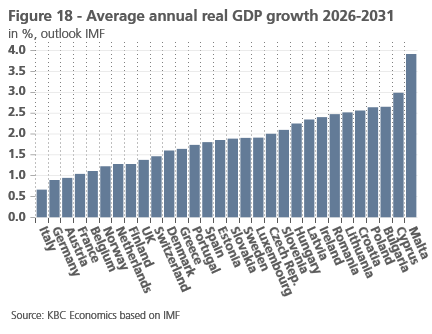
Last but not least, continued attention must be paid to strengthening the growth potential of the Belgian economy. The higher economic growth, the easier it will be to restore public finances to health. If the IMF's medium-term outlook is to be believed, average annual real GDP growth in Belgium in 2026-2031 will be among the lowest in the EU27 at only 1.1% (see figure 18). To avoid such a scenario, potential growth must also be strengthened. This will continue to require additional reforms (including on the functioning of the labour market) in the coming years. More generally, it remains important to create a favourable environment through reforms in which companies invest, innovate and create jobs and it pays for citizens to fill those jobs. Extra efforts must be made to increase the employment rate. According to the latest estimate by the Federal Planning Bureau, the employment rate will reach 74.4% by 2030 if policy remains unchanged, from 72.8% in 2025. That figure implies a still wide gap with the 80% target that the government has set as a goal.
Footnotes:
1 See A. Maravalle and L. Rawdanowicz (2020), “How effective are automatic fiscal stabilisers in the OECD countries?”, OECD Economics Department Working Papers no. 1635.
2 The support measures taken to limit the economic impact of the crisis are not counted as one-off and temporary measures (the so-called 'one offs'), in accordance with the European guidelines under the Escape Clause. Consequently, they are partly counted as part of the structural balance (partly as expenditure on temporary unemployment belongs to the cyclical component).
3 Mathematically, the endogenous change in the debt ratio is represented by: Dt - Dt-1 = Dt-1 x (it-gt)/(1+gt) – Pt where Dt, Dt-1 = the debt ratio at the end of year t and t-1 respectively; it = the implicit interest rate on government debt in year t (i.e., interest payments in year t divided by the debt in year t-1); gt = nominal GDP growth in year t and Pt = the primary government balance in year t. The formula shows that even in the absence of a primary deficit, the debt ratio increases (decreases) when the interest rate on outstanding debt is larger (smaller) than nominal GDP growth. This mechanism of automatically thickening (shrinking) the debt is called the (reverse) snowball effect.
4 In the simulation, we assume real (potential) GDP growth of 1% and inflation (based on the GDP deflator) of slightly above 2% in the medium and long term. We let the implicit interest rate on the debt gradually rise to 3.85% in 2040 and leave it unchanged thereafter.
5 For a recent overview of the literature on this topic, see P. Heimberger (2022), “Do higher public debt levels reduce economic growth?”, Journal of Economic Surveys.
6 See World Bank (2026), Worldwide Government Indicators and European Commission (2026), Report on Public Finances in EMU.