
The futility of Bessent’s long-term Treasury buybacks

In what’s widely interpreted as an effort to bring long-term rates down, the US increased the maximum ceiling of Treasury buybacks. Yet the policy largely failed to suppress long-term yields and caused the dollar to depreciate. This is because the operation was unexpected and largely seen as political (being implemented right before the midterms). The market thus largely rejected Bessent's liquidity-only narrative for the buybacks. The operation also fails to address the key underlying reason for rising long-term yields, i.e. the US government debt problem.
Long-term Treasuries have been under severe pressure this summer. The 30-year Treasury yield increased from 4.91% at the end of June to 5.31% by 17 August. This rapid rise is assumed to have prompted the US Treasury to intervene. On Wednesday 19 August, it increased the maximum size of its buyback operations for securities in the 10-to-20-year and 20-to-30-year sectors from a ceiling of $2 billion per operation to "at least" $4 billion per operation. This adjustment takes effect on 9 September and runs through 4 November (the day after the US midterm election).
The government’s wish to bring down longer-term yields is understandable. Not only do these yields influence federal government borrowing costs, they also heavily influence long-term mortgage yields (see figure 1). These yields also increased substantially over the summer. As the large majority of US mortgage holders (around 90%) opt for 30Y fixed mortgages, this recent rate rise makes housing even more unaffordable for aspiring homeowners.
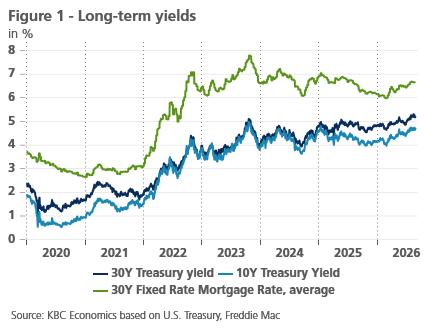
The policy change has largely failed to achieve its stated purpose, however. Though 30Y Treasury yields dropped 10 points on the day of the announcement, they have rebounded strongly and were close to their pre-announcement levels two days later. Yields dropped again last week, though the decline in oil prices might be a more important driver here.
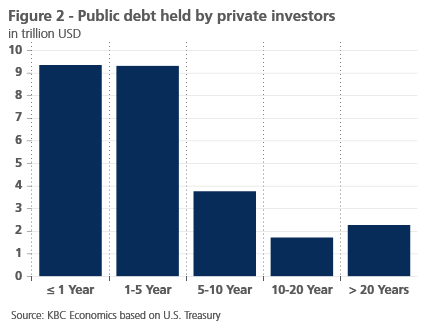
Part of the explanation for this subdued reaction is the small size of the operations. 4 billion USD per operation remains a drop in a bucket even for the less liquid longer term Treasury market (see figure 2).
Yet the key reason for its failure is that the operation fails to address the underlying problem. The US government debt is on a worrying trajectory. The US deficit is expected to reach 6% this year and will gradually rise to 9.1% by 2056 according to CBO projections (assuming unchanged policy). Interest payments are expected to account for an increasingly large chunk of this deficit (see figure 3). Interest payments already accounted for 3.2% of GDP last year and are projected to increase to 6.9% by 2056. Consequently, the US debt held by the public is projected to rise from around 100% of GDP today to 175% in 2056.
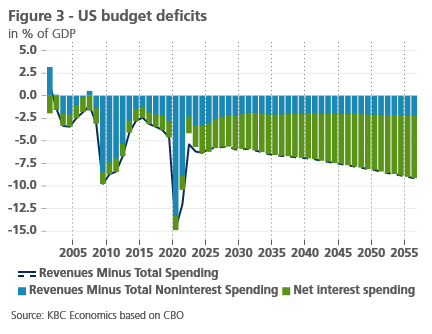
Rather than solving the underlying issue, the Treasury operations will likely exacerbate debt sustainability concerns. Because of these operations, the US debt will have a shorter overall maturity (as the purchases will have to be financed with short-term bonds). This makes US government finances more sensitive to interest rate shocks.
Are Treasury operations like these always doomed to fail? Not necessarily. Yet they should only be used to solve short-term liquidity issues. Treasury buybacks have been issued in the past to allow holders to exit illiquid positions. Yet that is not what is happening here. Though Treasury Secretary Bessent described the buybacks as a liquidity operation, markets viewed them as a larger operation to suppress long-term yields (ahead of the mid-terms).
As the new Treasury interventions are widely viewed as political rather than economic, they also further eroded the credibility of US policy making and made investors more skeptical of US assets. The trade-weighted index of the USD declined by 0.5% after the announcement. Gold prices also rose. The weaker dollar raises inflationary pressures and thus puts further pressure on the Fed to raise rates in September. This is unlikely to be the result Bessent hoped to accomplish.